Saturday, September 22, 2007

One Crow For Sorrow


Death seems more common here in the north. Not death itself, which is a part of life, but tragic death. The death of young people. Last year it was the plane crash. On my first day here in McPherson there was a funeral for a girl who had commited suicide. Today, the husband of an employee at the store was killed in an accident out on the Dempster.

Last night she was excited because he was coming home from working away. She hadn't seen him in a while. He made it home ok, but this morning I learned that he had been killed on his way back to work. I had just delivered them a new washer the other day. I had just ordered them a new king size bed. It hasn't even arrived yet. I wanted to drive down and see her. But I didn't have to because she came in to the store with her kids. You could tell she was crying. Her kids were crying openly, but they bravely marched through the store, picking up some odds and ends, and then renting some movies. I approached her and told her if she needed anything to call. An empty gesture, but one I felt I had to do. I couldn't just look away.


Last week, a bootleger from town rolled her car and walked away unharmed. You can't help but wonder why a hard-working family man could be taken in the same way a week later. I know it's wrong, but I can't help wishing it had been the other way around.

Thursday, September 13, 2007

Ft. McPherson Journal - Part Two

Days 5 through 10
WORK

Day 11
It's finally my day off. I was going to take Monday off, but the office lady ended up taking it off instead, which was fine because it rained all day Monday. Today it is warm and dry. I'm planning to drive about 200km south on the Dempster to Eagle Plains, a mid-way truck stop. All week I've been psyching myself up for this trip. Whenever tourists have stopped into the store on their way to Inuvik, I've asked them what the drive is like between Eagle Plains and McPherson. Everyone I asked said it was the most scenic part of the highway. That works for me because I won't be able to drive the next leg of the highway (400+km to Dawson).

Of course as I'm getting ready to go, a truck shows up with freight for the store. They never come when you need them, but always arrive when you're in the middle of something important (like a day off). I go in to help but Mike, the grocery manager, chases me off.

My truck is loaded with junk food, camera gear and fishing gear. I'm thinking about eating lunch at Eagle Plains, but I've brought a sandwich just in case the food there is crappy and/or expensive.

It's a five minute drive from McPherson to the cable ferry which crosses the Peel River. It looks like I'm the first truck of the day. The sign says that the ferry runs 9:30 a.m. to 12:45p.m. There is an old guy directing traffic onto the ferry. The trip across takes less than five minutes, but he comes over and asks me where I'm headed. I tell him and he tells me that I might see some Caribou. There are several herds that migrate across the highway. I pray that I'll see some wildlife. One lady who works at the store warned me not to get out of my truck if I see any grizzlies. Good advice if I ever heard it.
The highway rolls between some small hills and lakes before rising onto a plateau. Right away I stop at a look off and snap a few pictures of the mist filled Mackenzie Valley below. The sun is still quite low in the sky and I hope that it will be that way when I get to the Richardson Mountains. Any photographer will tell you that early morning and late evening are the golden hours for photography. It's that time when everything has a golden hue and shadows are more dramatic.


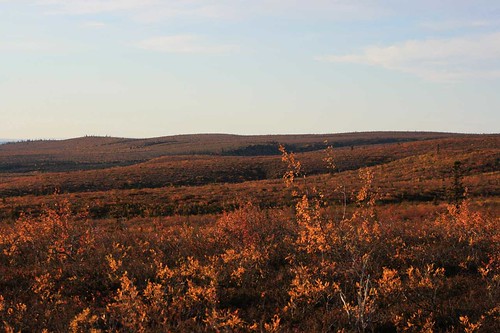
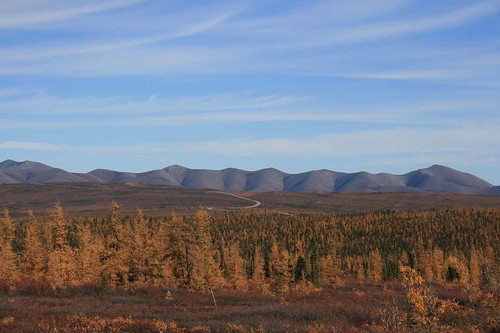
I think that the leaves are just a few days past their prime, but the colors are still wonderful. There aren't many trees here on the plateau and the low bushes are varying shades of yellow and red. Down below I can see some mountains, but nothing too spectacular yet. The road is in good shape; very smooth for a gravel road.


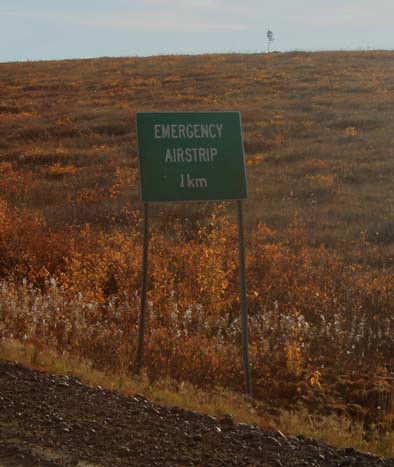
Up ahead I see a sign that says "Emergency Airstrip 1km." It takes a minute for me to realize that this runway isn't beside the highway. It is the highway. The road widens for a few hundred yards and then narrows again. There are orange and red markers on the side of the road. I wonder how often this runway is used.

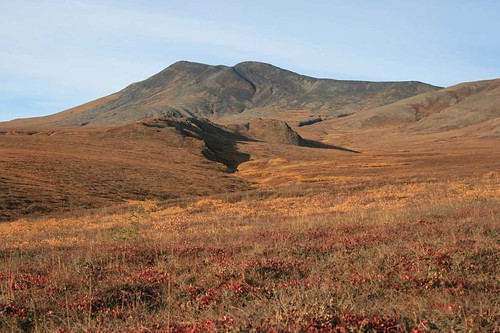
Past the runway I see what I've been waiting for: Mountains. And the road appears to be headed straight for them. I can't help but stop every few kilometers to take a few more pictures of them. IT makes me wonder if I'll ever get to Eagle Plains. Especially when I stop to try fishing at a small nameless creek. As usual I don't have any luck.


Close to the mountain pass they are grading the road. Dump trucks loaded with gravel are barreling up and down the road. It is intimidating to come upon one of these things as they head at you at nearly 100km/h. I move as close to the shoulder as possible. I picture these monster trucks jack-knifing and sliding into me. I picture myself loosing control on the loose gravel and sliding into them. But each time they pass without incident.


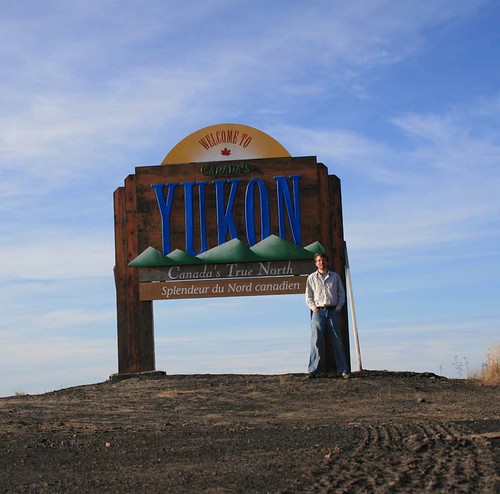
Down through the mountain pass is a flat section and then another smaller pass. In the middle of this second pass, I cross over into the Yukon. I stop for the obligatory picture at the border. Some of my earliest memories are of my dad reading Robert Service to me. Now I am finally in Service's home territory.


Passing in to a different jurisdiction, I instantly notice a difference in the quality of the roads. I'd say they are slightly better than on the Territories' side. The mountains aren't quite as impressive, but beautiful in their own way nonetheless.


It is noon when I cross the border. It has taken me two and a half hours to go 100 km with my frequent stops. I try to push ahead while the road is good and the scenery is mundane. Before long I come to the Arctic Circle rest stop. More obligatory photos, then back on the road.


Eagle Plains, as a destination, is a bit of a let down. I almost knew this would be the case. It is an ugly hotel, restaurant, and gas bar. It was built in 1978 because there was no natural stopping point between Dawson and McPherson. It obviously hasn't been renovated since. It's like walking into a time capsule. A plaque on the wall explains how the site is completely self sufficient as far as power, water, and sewer go. The plaque even brags that TV signals in the rooms come from an "ANIK 2 satellite dish." Wow, the future is here.

There's an old hound dog asleep on the floor in the hotel lobby. I take one look at the restaurant and decide to eat my sandwich instead of eating here. It's cafeteria style, complete with orange plastic trays and coffee mugs straight out of the 70s. The carpet and walls are ugly earth tones. I get the heck out of there and go eat my lunch by the Eagle River. At least the earth tones there are real.

Then it's back the way I came. Nothing much happens until I get close to the border again. I come around a bend and there up ahead is a bull moose, facing towards me and not moving.

Like I said before, delivery trucks are never there when you need them, and always appear at the most inopportune times. As I pull over, I know that about three minutes behind me is an 18 wheeler with a load of vehicles for Inuvik. Somehow I manage to steer the truck over with one hand while reaching for my camera with the other. For some unknown reason I happen to have my zoom lens on my camera. I can't even remember putting it on, but I'm glad it's there now. I manage to rip the lens cap off and snap a few pictures before the 18 wheeler flys past me, scaring the moose into the bushes. I pull ahead to where he was, but there is no sign of him. There's no sign of my lens cap either. I must have tossed it out the window in my mad rush to get my camera out.


Even though I make better time on the way back because I'm not stopping every five minutes, the trip seems longer. I've got my Ipod to keep me company. I arrive back in McPherson right around five o'clock. The trip has taken seven and a half hours. I've burned just over half a tank of gas. At McPherson's prices (1.36/L) that's about $70.00. I don't think I'll be topping that trip any time soon.

Wednesday, September 05, 2007

Ft. McPherson Journal - Part One


Day 1,
The company has sent me to Ft. McPherson to do a five week relief for a store manager who is on vacation. In honor of my first trip above the Arctic Circle, I've decided to stop shaving until I return south again. I haven't told Nicole this yet. I'm not sure how she'll take the news.
I arrived at the Inuvik airport around 1pm on Friday. Shane, the Ft. McPherson store manager was there to meet me. I came equipped with one bag full of clothes, my camera, and fishing pole.

We drove into Inuvik. It is an ugly town in otherwise beautiful surroundings. Shane had to pick up a part for his water pump, and we went to the North-Mart for some dirty bird (KFC). While waiting for our food, we went down to check out the electronics. I found the fishing section and on an impulse, bought myself a new fishing lure. I'm fairly sure most lures are designed to catch the eyes of fisherman rather than fish. This one was matte black with fluorescent red spots. It's called "the black fury." Even as I was forking over the cash, I wondered what the hell I was doing. It probably won't work anyway.

After picking up a day-old copy of the Globe and Mail (half price!) we got on the Dempster Highway, heading for ft. McPherson. The Dempster highway stretches from just outside of Dawson City to Inuvik, passing mostly through the Yukon before crossing into the territories just above the arctic circle. The highway is only about twenty six years old. To even call it a highway is misleading. It is a well built gravel road with a speed limit of 90km/h. In the winter it becomes an ice road.

The Dempster attracts scores of tree-huggers,weekend warriors, RV-ers, and tour buses. We passed all of the above on our way down. I felt bad for them knowing that their goal was the uninspiring town of Inuvik. Once there, they would have to turn around and drive back. You could see the cloud of dust raised by oncoming trucks a mile away. Slowly but surely they would approach. Both vehicles would slow a bit and move to the side. Some trucks didn't seem to slow at all, and our windshield would be pelted with tiny bits of gravel.

The view was mostly monotonous but strangely beautiful. The trees are in the prime of their fall colors up here. We drove past mile after mile of skinny fir trees and stunted birch with bright yellow leaves.
The Dempster crosses the Mackenzie river at the town of Tsiigehtchic(pronounced sig-a-chick, formerly called Arctic Red River). The M.V. Louis Cardinal ferries vehicles between the eastern side of the river, the Dempster highway on the western side, and the town of Tsiigehtchic, which is separated from the highway by the Arctic red river. We arrived at the river just as the ferry was pulling away with only one vehicle aboard. First it went over to the highway. Then it picked up someone there who had to go to Tsiigehtchic. finally, after about half an hour, it came back for us. Everyone I've spoken to curses the ferry, probably because they have all arrived, as I did, just to see it pull away. However, waiting half an hour is a small price to pay for mobility.

Day 2

You can judge the size of a town in the north by how many RCMP officers it has. Tulita has two. The Wells has four. McPherson qualifies for five.
McPherson (pronounced either Mick-FUR-sun or Mick-FEAR-sun) has about twice the population of Tulita at 800 people. It looks like so many northern towns, with dirt roads and standard northern housing. But there's something about it I like, although I cannot yet tell you exactly what it is.

Day 3

I drive Shane and his wife Alyssa into Inuvik so they can catch their plane. It is Labour Day, but the news stand is still open. I pop in for a Globe and Mail but the rack is empty.

"Do you have any copies of Saturday's Globe in the back?"

"Sorry, all sold out."

I drive around Inuvik for a bit, but there is nothing to see. Ugly residential sections and even uglier industrial sections. The speed limit in town is thirty five. My truck won't even go that slow. I have to accelerate and then coast. I decide to get the hell out of there and back on the highway. I never would have thought that driving one-ten on a dirt road would be so easy. About and hour and a half into the trip, I feel the rear end skidding out as I go around a turn. It is enough to make me back off to ninety.

Day 4

My first full day running the store on my own. The day seems to be going well until I go to put on my glasses after my shower. When I pick them up from the table, the right arm stays behind. I find the screw, but no amount of fiddling can get the damn thing to stay in. So I improvise. I use a bent staple in place of the screw and tape to hold it together.
After work, I get in the company truck, determined to get a line in the water. Out on the highway, the sun is low in the sky. CBC is on the radio.

"I'm Paul Kennedy. This is Ideas."

I cruise just over that next hill for several minutes, certain that I spotted a good fishing spot last week. Finally I stop at a lake that looks as good as any other. There is a small space on the side of the road, just large enough to park a truck without impeding traffic.

To get to the water, I soon realize that I'm not walking on ground at all. I'm walking on thick underbrush: dense and springy shrubs that grow out of marshy bog. It's ok for walking, as long as I look where I'm going, but as soon as I stop, the shrubs slowly give way. I cast twice before I start to feel the bog water seeping through my Adidas.

"To hell with it," I say.

However, my fishing is soon interrupted. It is silent out here, even though I'm less than a hundred yards from the so-called highway. But coming from the other side of the lake, I can hear someone calling "Hello!."
It is most definitely human. Of this, I am at first sure. I'm taken aback because it is out of place. I would have been less surprised to see a bear.
There is no sense of panic in the voice. Not much friendliness either. After two hellos, I yell back. There is another hello back, exactly the same as the last. It must be some lost hiker, I think to myself. Or someone fishing on the other side. There it is again.

"Hello!"

"Are you alright?" I yell.

"Hello!"

"Hello?"

"Hello!"

Then I see it. A loon swims into sight. I feel so stupid. luckily there is no one for miles who might have heard me. I guess he spotted a wet footed boobie and he wanted to move in for a closer look. Later his partner appears and they watch me fight with my lure, which is caught on a bush at the water's edge.

I don't stay long. About half an hour. But when I get back in the truck, Paul Kennedy is gone. The local radio station has taken over the frequency. With Buck Owens singing in the background, a woman is reading messages in that slow, monotone northern accent.

"This message is for Andrew Snowshoe. please Go down to the end of miller creek tomorrow to meet Judith and Dan. This message is for Ira Koe. If your listening, call home on channel 22 for an important message..."

Buck Owens comes through the AM radio loud and tinny. They call it country music for a reason. It's enough to drive you insane in the city, but I don't think I could handle anything post nineteen-eighty while driving into a dirt-road town with clapboard sidewalks. A kid is walking up the road and firing stones at a light pole, just to see if he can hit it. The sun is setting on my left, and there's a cloud of dust rising behind that truck that is driving this way.

Sunday, August 26, 2007

The Wells


I’ve had a lot of people say that life here in the north must be exciting. The truth is that life in the north can be weeks or months on end of boredom, followed by a few hours that make up for those boring stretches. I had one of those experiences last week. The company sent me to Norman Wells, the next town up on the Mackenzie River, to work for a week at the Northern Store there.

As I mentioned in a previous post, Norman Wells takes it’s name from the oil wells that Imperial Oil tapped into during World War Two. They are still pumping oil and natural gas today. Most of the houses in town are hooked up to cheap natural gas for their heat and hot water. They pave the main roads using oil (possibly mixed with some other chemicals) to stick the top layer of dirt together. One person told me that biologists have found fish downstream in the Mackenzie are dying from oil poisoning, although skeptics say that there has always been oil seeping from the ground into the Mackenzie.

Norman Wells is the hub of the Sahtu region, thanks to it’s airport. Most people consider it the place to be amongst the five Sahtu communities. It has several restaurants (four by my count), two stores, several gift shops, and a museum. It also has a liquor store and at least three bars. I’ve often heard it described as the “whitest” of the five communities. The population is predominately made up of energy sector workers brought in from the south.

The Northern Store in The Wells (nobody calls it “Norman Wells,” in day-to-day conversation) is a sight to be seen. I’m used to working in a big bright new building with high ceilings and tiled floors. In the Wells, the store was constructed by connecting seven ATCO rental trailers together. There are metal seams in the floor that become insurmountable speed bumps for your shopping cart. The shelving is old and dented, the aisles are narrow, and the fridges and coolers break down on a regular basis. The ceiling leaks all over the place. Midway through my stay, the power in the bathroom stopped without warning. No breakers were blown. Before I left, it came back on for no reason, but when I turned on the ceiling fan it started spraying water that had pooled in the fan’s plastic casing.

Despite its deficiencies, The store has some of the highest sales among similar sized stores in the company. They carry high end items that wouldn’t sell in most other Northern communities. Want crab legs, lobster tails, or premium steaks? They have them at the Northern. The store also has one section of shelving devoted entirely to “Newfie” items such as purity cookies, hardbread, and Lee’s Snowballs. They also sell buckets of salt beef. There are a lot of Newfoundlanders working in the oil business.

The week was uneventful. Work is work, and keeping shelves locked is rarely exciting. The best part of my job is meeting the characters who come in the store. One day, a Newfoundlander named Dudley introduced himself and started haggling over the price of a frozen turkey. He told me that he worked for Aurora college, but he was also the justice of the peace and the coroner. He was often in the store throughout the week. Once he came in to return a defective cordless phone.

“We’ll have to order another one in,” said the manager. “That was our last one.”

“But what do I do in the meantime. I got no phone.”

I couldn’t help interrupting.

“Here’s what you do, Dudley. Get yourself two tin cans and a piece of string…”

“Oh, yiss b’y. Where’d you say you came from?”

The housing there was nice. The Northern Store owns a duplex for it’s employees. I had a three bedroom house all to myself for a week. Around six thirty on Sunday morning, , I awoke to the sound of wood crunching. It was my only day to sleep in, but the sound was urgent enough that I managed to pull myself out of bed and look out the window. I could see that our front fence had been flattened and a white truck was pulling away. He had been backing out of the driveway across the street and had gone a bit too far. I cursed, got out of bed, and called the RCMP. Later that week I had to go give a statement. Apparently there was a second witness and the Mounties told me they had their man.

While all of this was fun, it was my last night in The Wells that made it all worth while. My friend Ron Oe, who took me fishing up on Great Bear Lake last year dropped by the store. I had run into his wife earlier in the week.

“How would you like to take the quads up to the mountains?”

I couldn’t say no to that one. I didn’t get out of work until eight thirty. Ron has two Honda four-wheelers which he bought for a song and then fixed up. It helps that he is a trained mechanic. We topped of the gas tanks and then roared off up towards the dump.

It was a beautiful night. After a week of rain and overcast skies, the air was warm and the sun was low in the sky, giving the landscape a golden glow.

I had never seen the appeal in four-wheeling before. My only experience on one had been bombing up and down a short logging road at my friend’s house when we were teens. Now Ron and I were flying through a maze of narrow trails, sometimes cutting back down the hill, other times launching up steep gravel banks. Before I was usually perched on the luggage racks while someone else drove. Now I was in control, and the feeling was exhilarating.

Finally we got up to the ridge above Jackfish Lake. Without warning, I looked to my right and saw nothing but some tiny trees four hundred feet or so below. But the path was solid and well maintained. I at no time felt as if I was in any danger. We stopped the quads and took in the view. Ron lit up one of his trademark captain black cigars, and I crawled on my belly to the edge of the cliff, sticking my nose out over the edge. Across the valley were even taller mountains. Ron told me that a local helicopter company takes people up there on the twenty first of June. From that height , you can watch the sun swing around the entire horizon without setting. However, tonight the sun was settling low at the end of the valley. Fortunately, sunsets last for hours this time of year, so we decided to head down to Jackfish Lake.

The town has developed the lake beautifully. Ant the end of the road they have a few campsites with fire pits. There is an unobtrusive path leading down to a well maintained dock. A battered canoe and a small zodiac were tied up, free for anyone to borrow. There were also two observation decks built into the side of the hill, where parents could sit and watch their kids swim. The water was crystal clear. A school of minnows was swimming below the dock, and two loons were out on the lake.

Climbing back on the quads, we roared up out of the valley and stopped to take in the view of the town before heading home. Lights were coming on in the twilight. The Mackenzie river snaked southward and northward as far as the eye could see, and the silhouette of the Mackenzie mountains loomed above the river, their jagged peaks finally free from cloud cover that had obscured them all week. I didn’t bother to bring my camera, and at the time I wished I had. Now I know it would have only slowed me down. The most expensive camera available would not have done the views justice. We were gone only two and a half hours, but I would gladly toil for another six months in the store for a few more hours such as those.

Sunday, August 12, 2007

A trip to the outside

When Pierre Burton lived in Dawson city as a child, he said that people referred to anywhere south as the “outside.” If you weren’t cooped up in Dawson for six months of winter, you were “outside” in the rest of the civilized world. While it is not quite that bad here in Tulita, I can say that seven months in the same small town can get to you. I have felt the first hints of cabin fever, and although I could always get on the internet or turn on the TV, after seven months you need a change of scenery.

We left for vacation of July 7th. 07/07/07. The luckiest day of the year. And I was inclined to agree. I had just spent six weeks running the store, shorthanded. I was burnt out to say the least, and in the last few days before we left, I started to not care that things were less than perfect at the store. My one useless stock boy had buggered off, and the cashiers were showing up late and leaving early. But none of that mattered. I couldn’t even sleep the last few nights. I had finally recaptured that feeling one gets in the run-up to Christmas when one is six. But this was going to be better than Christmas. Christmas is a mere day. I was looking forward to three weeks in the civilized world.

Leaving Tulita is no small feat. One must first board a plane at the airport and fly twenty minutes north to Norman Wells, Imperial Oil’s bastion of the north. Unlike every other nearby community, Norman Wells is a fairly new town. It was founded in the 1940s because of its oil reserves. The Americans built a pipeline to help the war effort. From there you catch a Canadian North flight to Edmonton, with a half hour stopover in Yellowknife to go through proper security. It is clear that the Canadian government doesn’t care what you bring north of sixty on a flight, but god help you if you try to bring anything back.

We got a ride from the Norman Wells airport with Larry, owner and proprietor of one of the local hotels. As we were driving into town, I noticed that the van wasn’t kicking up a cloud of dust.

“What do they use on the roads around here?” I asked Larry.

“Oil.”

“Oil?! Like, crude oil?”

“Oil. It’s better than dust.”

Anywhere else in Canada, if your furnace tank leaks, Environment Canada will come dig up your front lawn and leave you with a $20,000 bill. In Norman Wells, they spray it on the roads.

It was so strange to be somewhere other than Tulita and to know I would be without responsibilities or deadlines for the next three weeks. I picked up a copy of the Globe and Mail. It was the first time I had seen a newspaper that wasn’t at least a day old in seven months. Nicole often brings me back newspapers when she travels to Yellowknife. I hoard them like gold and often read every column and section. Even papers that are a month old have interesting stories. Our store gets only one paper a week. It’s a northern publication called News North, and even that arrives a day late. Sure we have the internet, but it’s not the same as seeing the news in black and white.

We ate at Larry’s hotel (which also has a small restaurant). It was the first of too many meals out. Our flight to Edmonton left at three. We boarded a 737 without even going through a metal detector. It’s still a strange feeling in this day and age.

I thought that my return to civilization would be a bit of a shock. More than one person had warned me that the pace is often too much for people who have spent a lot of time in the North. To me, it was as if I had never left. But it was strange to see a group of people and not know the names of any of them. Working at the store, I know the names of almost everyone in town.

With our luggage checked, we wandered around the airport, waiting for our flight to St. John’s. At one point, a businessman who was walking in front of us suddenly stopped and spun around.

“Hey Michael! How’s it going?”

Nicole and I jumped back and stopped. It was only then that I noticed the tiny Bluetooth headset resting on his ear. We both kept walking and laughed to ourselves. Later, a security guard whizzed past on a segway scooter. The future arrived while I was away.

Our flight to St. John’s was hellish. We somehow ended up in the emergency exit seats. They don’t recline, and since we were in the aisle and middle seats, sleep was all but impossible. There were seventeen empty seats in first class by my count, but the stewardess would not let us sit there.

“I’m sorry sir. I can’t upgrade you to first class.”

I wasn’t asking to be “upgraded” to first class. I just wanted to sit there and sleep for a few hours. But I let it go.

We arrived in St. John’s on Sunday the 8th at ten thirty local time. Nicole’s dad and sister were there to meet us at the airport. Her mom was home cooking up a massive “sunday dinner.” Besides a turkey and glazed ham, we had potatoes, turnips, carrots and cabbage boiled up with salt beef, and too many other sides to mention.

The next morning, five of us climbed into a new Daewoo car for an 11 hour drive across the entire island of Newfoundland. Our destination was Rose Blanche, a small fishing village on the south west coast, near Port-aux-Basques. It is the ancestral home of the Light’s Family, and it is where Nicole and I bought a small house with some of our savings from our first year in the north.

The drive was eventful to say the least, but I promised not to record any of it. These are my future in-laws, after all.

We arrived at our house at nine-thirty that night, just as it was getting dark. Having never seen the house in person, it exceeded all of our expectations. Nicole’s cousins came over and we had beer and pizza. Then we spent the night talking and checking out the features of the house.

The next day was mostly spent visiting relatives. First cousins Dave and Dianne. Then Aunt Marie and Uncle Willie, then cousin Tanya and Aunt Geraldine. And finally, Aunt Rose, who is actually Aunt to nobody. As Farley Mowat wrote in his book, Bay of Spirits, “Aunt” is a title bestowed on respected women all along the southwest coast of Newfoundland. She welcomed us into her house, which was lined with pictures of her children (one of whom is now a doctor). She offered us a drink of whiskey, noting that the doctor had told her a small drink was good for her now and then, as long as it was mixed with water.

“I like to mix mine with ginger ale though,” she said with a false whisper and a big grin.

Although seeing old friends was fun, by the end of the day that feeling of Christmas returned. I had been out visiting relatives when I really wanted to be home, playing with my toys. Only this time, the toy was my home.

The next morning we left for the east coast again. We stopped for a night in Corner Brook to look up old friends, most of whom were not home or had moved on.

The next week in St. John’s was uneventful. We spent our time visiting tourist attractions and going to the mall. I bought a few shirts, but even flush with cash I was unable to bring myself to spend 25 bucks on a shirt or 50 for a sweater. Fashion in the north tends towards the practical rather than the stylish. What I did buy was books. About 15 by the end of three weeks. I walked through Chapters, grabbing anything that looked interesting. It was the one pleasure I refused to deny myself. At one point, while carrying about seven books, a customer stopped me and asked me if I worked at the store. I guess he needed some help.

On Monday the 16th we went downtown to see the White Stripes concert. Although we had floor tickets, and although we started out very close to the stage, the notion of standing for two hours amongst a bunch of pierced and colorful teenagers didn’t appeal to us fogies. Luckily, Mile One Stadium has a restaurant up among the private boxes. We got two seats with a prime view of the stage. Jack White looked kind of small, but we could hear him fine and the beer tasted good.

The next day we flew to Nova Scotia. We spent a lot of time visiting family and friends, and there was more shopping. It was over all too quick. On the way back to the north, we stopped for a night in Edmonton and spent an afternoon at the West Edmonton Mall, once again buying almost nothing.

I will admit, it felt good to get back to Tulita. That really surprised me because I couldn’t wait to get the hell out of here when we left. Too much of anything (or anyplace) is a bad thing. Now I’m ready for another year.

After having spent a year in relative isolation, I’ve compiled a list of things you should not take for granted:

1. Family and friends
2. Bookstores
3. Cold beer with family and friends
4. Long drives to nowhere in particular
5. Fresh meat and vegetables
6. Newspapers (especially the weekend edition)

Everything else you can probably live without.

Friday, August 10, 2007

Flash Happy

When we went on vacation in July, Nicole and I were in an unusual position. For the first time in our lives we had cash, but we didn't need anything. In the past year we had learned that living in the north wasn't exactly roughing it when it comes to getting day-to-day needs, meaning we didn't need to stock up on any items. We could only bring back what we could fit in our suitcases. I didn't want to spend money on expensive clothes that would only be ruined by days at the store. My one major purchase (besides a suitcase full of books) was a new digital SLR camera.

Tulita means "where the waters meet" in the local language. Here you can see the cold and crystal clear waters of the Bear River merging with the muddy waters of the Mackenzie. There is probably a 10 to 15 degree temperature difference between the waters. There is supposedly good fishing on the border of these two waters, although you need a boat to fish there.

The slopes of Great bear rock as seen from the air.

Another part of the rock. The swath cut through the trees in the center of the picture is the winter road.

Bear rock from the airport.

This picture was taken at the dump. This doesn't show how incredibly big these ravens are.

The Mackay Range mountains are a dominant feature of the landscape around Tulita. The first picture was taken from my yard. The second from the airport above town. I'm beginning to wonder when I'll get tired of taking pictures of this scene.


Bears in their natural habitat. (I wish).


Ursus aviation is the local charter company. Their motto is: "Don't be fooled by the orange and brown paint job or the orange shag carpeting in our planes. We do regular engine maintenance!"

Believe it or not, Mac the dog can fly. I have proof in these two pictures.


A chance picture I took one Sunday morning. That's the old Hudson's Bay warehouse where we keep our furniture.

Images of the Norwetta heading south on the Mackenzie. Customers pay upwards of $5000 for a week-long one-way trip up the Mackenzie.


Monday, August 06, 2007

Dangerous Creatures


Last Thursday night I took the dog for a walk on the beach. It was getting late, and I had already driven up to the dump to get some pics of the bears with my new camera. But when I returned, Mackey was jumping around at the door, which is her way of asking to go out for a walk. So I took her down to the beach.

It was an uneventful walk, as far as I could tell. But when I got her back to the house, Nicole noticed something.

“Mackey has a splinter in her tongue!”

Mackey was sitting on the floor, looking up at us. Her tail was wagging and her tongue was hanging out. Sure enough, I could see a bi-colored splinter stuck in her lolling tongue.

“That’s not a splinter. That’s a porcupine quill.”

She was still looking up at us, apparently unaware that she had a huge spike in her tongue. I coaxed her onto the coach,. Then I tried to pry open her mouth and grab the quill. Her happy demeanor was quickly replaced by the scrunched up face of a resisting little child. As soon as I stopped she would resume panting and tail-wagging, her tongue hanging out as if to show off the quill.

The quill looked smaller than most I had seen. It didn’t seem to be in her tongue too deep, and she did not appear to be in pain. Yet I was beginning to worry. I had heard that quills slowly work their way into the skin. I had also heard that they have barbs like fishhooks that make them difficult to remove Throughout this whole ordeal, Nicole was very helpful. She mostly held Mackey’s head still and said things like, “Just grab it! Just yank it out!” Of course dog drool isn’t exactly sticky. It has what you might call lubricating properties. Any time I did manage to grab the quill, it slipped out of my fingers.

At this point, I did what any college educated person is bound to do when action isn’t working. I switched to research. A quick Google search of “porcupine quill in dog mouth” brought up all sorts of helpful links. They all showed disturbing pictures of dogs covered in quills and said things like:

“A few porcupine quills in a dogs face can usually be removed by the owner, but quills in the mouth will probably require a trip to the vet so that the dog can be sedated.”

I got up form the computer in disgust. A trip to the vet would probably cost us at least five hundred dollars. We would have to borrow a kennel, make arrangements to get her on the plane, make arrangements to pick her up. All because the damn dog had decided to see how a porcupine tastes.. I felt like an American parent who has learned their child has done something stupid and will need an expensive trip to the hospital.

The problem, I decided, was that Mac kept pulling her tongue into her mouth whenever I tried to grab the quill. If only there was some way to make her stick her tongue out.

I went to the cupboard and grabbed the extra large jar of peanut butter we had mailed to ourselves last year. I spooned some into a bowl, and then jammed my fingers into the mess.

“Here Mackey!”

Now instead of pulling her head away, her little tongue was darting in and out like a piston. This didn’t make grabbing the quill any easier. Neither did the great globs of peanut butter stuck to my fingers. At eleven o’clock, we gave up and went to bed.

In the morning, the quill was still there. Because she didn’t appear to be in any pain, we decided that there was no rush. Nicole made plans to call the vet for advice. We thought that maybe they could send up a mild sedative that would allow us to get the quill out.

As we were getting ready for work, Mac came in the bedroom and jumped up on the bed. She was lying on her back with her mouth open. Nicole and I looked at each other, and within seconds, she had grabbed the dog and I had grabbed the quill. It came out very easily, and Mac didn’t even flinch.