
What Happened?
We left. In January, a job came up back east. I applied. I got it. We left. Those last six months after my last post were great. We drove to Dawson city. The summer flew by. We flew back east in August and got married. In the end, opportunity knocked and we answered.
I could've written more post those last months but I was busy writing for the paper. The north was no longer foregin to me. I was begining to see it as normal. It was harder to pick out things worth writing about from a southerner's perspective. So I stopped, and focused on writing for the paper.
I've been thinking about the North a lot lately. I especially miss it in the summer months. Sometimes I find myself craving a drive on the Dempster. Sometimes I miss the view of the river from Tulita. I miss how the north was at once vast in size and small in community. Mostly I miss the people.
I thought I should sign on and let any readers out there know the end. Thank you, good night.
Wednesday, July 01, 2009


Saturday, June 07, 2008
A Very Large Day
My friend's dad used to have a saying. Whenever I was sleeping over at their house and we woke to a bright sunny Saturday he would look out the window and say, "Well. It's a rather large day out there."
He always put emphasis on the "large." I can still remember the first time he said it because I had never heard the saying before and yet I knew exactly what he meant. There were no clouds that day. The sky seemed so big and at the same time the day was full of potential. It was Large.
The other day I checked the "sunwatch" for the paper. It's a listing of sunrise and sunset times. The sun is now up. And it won't be setting until late in July. Yesterday was also one of the first warm days of the year. The first real t-shirt day. As I was walking the dog around boot lake it hit me that this is the largest day I've ever experienced. Summer is finally here, and the potential seems unlimited. We're going camping.
He always put emphasis on the "large." I can still remember the first time he said it because I had never heard the saying before and yet I knew exactly what he meant. There were no clouds that day. The sky seemed so big and at the same time the day was full of potential. It was Large.
The other day I checked the "sunwatch" for the paper. It's a listing of sunrise and sunset times. The sun is now up. And it won't be setting until late in July. Yesterday was also one of the first warm days of the year. The first real t-shirt day. As I was walking the dog around boot lake it hit me that this is the largest day I've ever experienced. Summer is finally here, and the potential seems unlimited. We're going camping.
Sunday, May 18, 2008
Two views of the north
A few weeks after I got to Inuvik, a British journalist named Oliver Burkeman dropped by our office. He was there writing about northern sovereignty, oil and gas, etc, etc...
His article was more negative than positive, in my view, portraying the north through the eyes of an outsider.
"It isn't hard, visiting the Canadian Arctic, to feel as though you have reached the back of beyond: a place at the edge of the map, empty except for the caribou and a few improbably hardy humans, who journey for miles to shop at Inuvik's solitary supermarket, which sells overpriced groceries shipped from "down south" - meaning the northern Canadian city of Edmonton - along with a small selection of snowmobiles."
Inuvik has three supermarkets, not one. It was the first of several errors in his article, "A very cold war indeed."
I duly reported them to the editor of the guardian, but I didn't receive a response.
Today I read an excellent article about another northern country, Iceland. It was called, No wonder Iceland and the happiest people on earth. (Also by a reporter from The Guardian.) I saw many similarities between what Iceland did during World War Two, and what is currently happening in the North as it embraces industry on its own terms. There is a similar view here of family, and of welcoming children. It's not, as reporters in the south might have you believe, a epidemic of unwanted teenage pregnancy.
Perhaps it is because my job is to seek out the good news, but I see such potential here. And when I read article's like Oliver Burkeman's, portraying the north as a backwoods and its people as pawns in the geopolitical game currently being played out, I can't help but get a bit mad.
His article was more negative than positive, in my view, portraying the north through the eyes of an outsider.
"It isn't hard, visiting the Canadian Arctic, to feel as though you have reached the back of beyond: a place at the edge of the map, empty except for the caribou and a few improbably hardy humans, who journey for miles to shop at Inuvik's solitary supermarket, which sells overpriced groceries shipped from "down south" - meaning the northern Canadian city of Edmonton - along with a small selection of snowmobiles."
Inuvik has three supermarkets, not one. It was the first of several errors in his article, "A very cold war indeed."
I duly reported them to the editor of the guardian, but I didn't receive a response.
Today I read an excellent article about another northern country, Iceland. It was called, No wonder Iceland and the happiest people on earth. (Also by a reporter from The Guardian.) I saw many similarities between what Iceland did during World War Two, and what is currently happening in the North as it embraces industry on its own terms. There is a similar view here of family, and of welcoming children. It's not, as reporters in the south might have you believe, a epidemic of unwanted teenage pregnancy.
Perhaps it is because my job is to seek out the good news, but I see such potential here. And when I read article's like Oliver Burkeman's, portraying the north as a backwoods and its people as pawns in the geopolitical game currently being played out, I can't help but get a bit mad.
Saturday, May 03, 2008
Night and Day
Spring in Inuvik is not like spring back East. Yesterday we got 10 centimeters of snow. The roads are now rivers of dirty slush. We have had some warm days. But warm up here is anything near 0C. Anything above 0C is downright hot.
Every day I have the trouble of deciding whether or not I’ll wear my light spring jacket, or my heavy parka. It comes down to whether I’d rather be a bit too warm, or a bit too cold.
At least the pussywillows are out. That has to count for something.
Last time I checked we’re nearing 18 hours of sunlight a day. We gain about 10 minutes every day, or over an hour every week. The strangest thing of all is that the sun now sets before it rises in the run of a day. Technically, a day begins at 12:00am. Lately sunset has been around 12:15am. And sunrise is around 5:00am. So technically, the sun sets before it rises. “Night” as most people know it is for a few short hours in the morning. The mind boggles.
Every day I have the trouble of deciding whether or not I’ll wear my light spring jacket, or my heavy parka. It comes down to whether I’d rather be a bit too warm, or a bit too cold.
At least the pussywillows are out. That has to count for something.
Last time I checked we’re nearing 18 hours of sunlight a day. We gain about 10 minutes every day, or over an hour every week. The strangest thing of all is that the sun now sets before it rises in the run of a day. Technically, a day begins at 12:00am. Lately sunset has been around 12:15am. And sunrise is around 5:00am. So technically, the sun sets before it rises. “Night” as most people know it is for a few short hours in the morning. The mind boggles.
Tuesday, April 29, 2008
If you enjoy this blog...
There are quite a few other bloggers writing about the north. Another blogger recently created some awards for the best NWT blogs. Quite frankly, I don't see how this can be for the "best" blogs since mine wasn't in the running for any of the awards. I've learned my lesson. It's nothing but shameless self-promotion for me from here on in.
If you are online tonight, you still have time to vote. Lots of good reading to be found.
http://bestnwtblogs.blogspot.com/
If you are online tonight, you still have time to vote. Lots of good reading to be found.
http://bestnwtblogs.blogspot.com/
Paulatuk

I woke up just before my alarm, around 6am on a Saturday morning, to catch my flight to Paulatuk. I was offered a seat on a charter by a resources start-up called Darnley Bay Resources. Myself along with two reps from the company arrived at the airport a bit after 8. Of course the plane was nowhere near ready to take off. The pilots had rolled in just before us.
Although they did their best to get the plane going, the pilots were at first unable to find someone qualified to drive the fuel truck. Welcome to a small town on a Saturday morning.
The mining guys shuffled impatiently and checked their watches. Representatives from the community corporation who were there to help the community did the same. This was funny because they were actually the owners of the airline, and they had no more power to speed things up than anyone else.
We took off about 45 minutes late. But then again lateness is just an idea created by people with watches. In the North, you’ll get there when you get there.
I was able to see the tree line once we got in the air. An hour later we came down through the clouds above the frozen Arctic Ocean. A string of dots lay on the treeless coastline. Welcome to Paulatuk.
They picked us up in a big shiny 15-passenger van and drove us three minutes to the school gym. From there I bid my friends adieu and set out on foot to see the town. The sun was out and it was just a bit below zero. At 10:30 on a Saturday morning, everything was quiet. There were no real signs of life except for the sled dogs tied out on their leashes.
I was drawn to one old building overlooking the water and spent a few minutes taking shots from different angles. Just about every other building in town was standard government housing. A hundred years ago, Paulatuk had whalers passing through. This one building may have seen wooden sailing ships docked out in the bay.
One old man I spoke to that morning by the name of Charlie Thrasher said he himself was a descendant of the whalers that came north to make their fortunes.
As soon as I told him I was from the paper, he asked me if I was getting it right. He didn’t specify what “it” was. He also told me that global warming is “bullsh*t” and pointed out all the snow around town to prove it. He said this is the latest spring he has ever seen, and he was most certainly well past 60.
Paulatuk has suffered through a lot of unusual blizzards this past April. It is usually to cold and dry to snow very much this far north. Although Mr. Thrasher might see more snow as evidence against global warming, it is more likely proof of climate change: more moisture moving in from the south and temperatures warm enough to allow it to snow.
The mining guys were in town to ask the community’s permission to drill on their land. Paulatuk is home to one of the great mysteries of the geological world. The Darnley bay anomaly was discovered in the 1950s by INCO Mining Corporation. The Geological Survey of Canada also knew of the anomaly. Although they never bothered to mention it until the 1990s, when Darnley Bay Resources staked the mineral rights.
It sounds like something from a Stephen king novel. The anomaly is a “blip” in the earth’s magnetic and gravitational field. It means there is a large, dense body somewhere below Paulatuk. The mining company is betting that it is mostly nickel and other metals.
82-year-old Leon La Prairie, the company president, is determined to get a drill bit down there to see what the heck it is. He was working for INCO back in the 50s when the anomaly was discovered. La Prairie chatted with residents and shuffled around the gym, leaning on his cane. At the end of it all, he got approval to do the test drilling.
Before the community voted, we were treated to a meal of caribou stew, caribou soup, and straight-up boiled caribou. It was good. At least the stew was. I wasn’t in the mood for soup, and the boiled caribou was more for the elders.
The mining company also brought Tim Horton’s donuts, which are a real treat up here, even if they are a day old. In the North, most communities make “traditional” or “Eskimo” donuts. These are a sweet, light, fried bread. There was a plate of these sitting next to the caribou stew. I ate three. Tim’s could take a page from Paulatuk’s recipe book.
The other thing the mining company brought was oranges. Two whole cases, to be exact. This was probably at the suggestion of an elder, or someone who occasionally travels to remote northern communities once every few years. People traveling to the North seem to think that kids are going to go wild for fresh fruit, or that they only get it at certain times of the year. I’ve read stories about barges coming up the Mackenzie at the turn of the last century. They would bring oranges and give one to every child in every town. I hate to break this to everyone, but it’s not 1942. They’ve got papaya and mangoes down at the northern store. Give the kids their donuts.
After the meeting there was a lot of hustling to get back on the plane and back to Inuvik. We had to go track down the pilots, who were sleeping off Friday night at the hotel. I was a bit concerned with the water they were guzzling on they flight back, but the landing was flawless. I slept most of the way. I wish I had more time to talk to the elders, and round up a few more stories, but you’ve got to take what you can get up here. I just hope next time I can get up there in the summer.Saturday, April 19, 2008
Ice Road to Tuktoyaktuk
Note: A slideshow of pictures from the trip is available at the bottom of the post (or by clicking here). I suggest opening the link and viewing the pics full sized.
The road to Tuktoyaktuk mostly follows the path of the Mackenzie River. It took us three hours to get there. For the first half hour we were stuck behind a large dump truck, presumably hauling a load of gravel to Aklavik.
For the first hour there wasn’t much to see. The road was solid ice covered with drifted snow. It was very clean. I recall flying past an empty can of red bull, and the elbow of a stove pipe. There was no other litter.
When you look at a map that shows the tree line, Inuvik is right on the edge. In fact we had to go about an hour and a half north before we realized we were above the tree line.
The road to Tuktoyaktuk mostly follows the path of the Mackenzie River. It took us three hours to get there. For the first half hour we were stuck behind a large dump truck, presumably hauling a load of gravel to Aklavik.
For the first hour there wasn’t much to see. The road was solid ice covered with drifted snow. It was very clean. I recall flying past an empty can of red bull, and the elbow of a stove pipe. There was no other litter.
There were hills to the left of us, trees and low shrub to the right. About an hour in, I saw something that seemed to stand out against the plains. Nicole dismissed it as small tress or shrubs at first, but as we got closer we realized it was a herd of reindeer.
Reindeer are domesticated caribou. There is little difference except in temperament and color. Reindeer are much more docile than caribou. A man on a snowmobile was leading the herd.
As I was standing up on a snow bank, snapping pictures of the reindeer, I turned and noticed an animal running on the other side of the road. At first I thought it might be a fox but after Nicole saw the pictures, she told me it was a wolverine.
Note: Correction. On closer inspection of the phots, it was a fox.When you look at a map that shows the tree line, Inuvik is right on the edge. In fact we had to go about an hour and a half north before we realized we were above the tree line.
One might think that thee tree line is just an idea, or that the end of the trees is a much more gradual process. It was, from what I can see, almost an invisible line. There is literally a point where the trees suddenly peter out to nothing. I was in a hurry to get home when I noticed this, so I didn’t stop for a picture. Maybe next time.
It wasn’t easy to tell when we left the delta and drove out on the Beaufort Sea. We kept checking our GPS. The frozen shoreline became apparent after a while. It was different that the hills in the delta. The road is build offshore, on the ice. The road is bright blue when it is not covered with ice. It is a strange, frostless ice full of cracks. Driving on the ice was smoother than driving on the gravel of the Dempster, with very few “potholes.” But it was wavy in places. When a truck was driving towards us with its headlights on, it bounced up and down ever so slightly so that it looked as if he was flashing his high beams at us. Occasionally you would hit a crack in the ice.
Tuktoyaktuk was visible long before we reached it. Near the edge of town you can see two “pingos,” which are distinct hills that are formed through the thawing of permafrost. I had seen at least a couple on the way up. They are impossible to miss on an otherwise snow covered tundra. I would love to see the tundra in the summer. In the winter, it is not much to look at. Perhaps that is why pingos are so loved among the people of tuk. They provide natural scenery. The area just outside of the town has been set aside as “pingo national park.”
Tuk looks like so many other northern towns, with a lot of the same government housing. I’m sure it would be pretty in the summer, and it does have its scenic parts. I ran into Sister Faye, someone I had only known as a voice on the phone. Nicole and I were up exploring the old churches in town. Sister Faye was going into “Our Lady of Grace” Catholic church to start up the furnace. She said that they now only use this church for Christmas, Easter, and confirmation. On this day she was getting ready for confirmation.
Sister told me to walk right into the church, and to check out the Anglican church as well, which was a small log building near the Catholic church. She said they always keep them unlocked.
I walked into both. The Catholic church was beautiful on the inside, with ornate woodwork and painting. The Anglican Church, true to its protestant roots, was more humble. It was all I could do to stop myself from pulling the rope in the porch that led to the bell.
There was a tiny, fold up pump organ near the altar of the Anglican church. It was the size of a large suitcase, and it hand a handle on the top. It looked old. I suspect it might have come up on a whaling ship. It looked as if it were designed to be used on a ship, brought out for Sunday mass no matter where the crew might be. Then again, it might have been ordered out of the sears catalogue in the 1940s.
I think I became fixated on the ship idea because there is a large wooden sailing ship not far from the church. It too is owned by the church, and Sister Faye told me that they will be having the ship and Our Lady of Grace painted this summer. The Anglican church is mostly bare logs, and except for the window trip it looks as if it has never seen a drop of paint.
Tuesday, March 11, 2008
Macro and Mac-Crow Photography
Macro photography is when you take pictures of objects on a very small scale, or get your camera lens in very close to the subject. (Yes, I took these).


Mac-Crow Photography is when I take pictures of my dog, Mac, fighting with a crow.


It was about 50 below with wind chill when I took these. The colour is off and the pictures are a bit out of focus. The worst part was when the crow (raven, to be more accurate) hovered on the breeze about five feet above Mac, as if taunting her. Just as I went to snap the picture, my camera was locked up, processing the ten other pictures I had already taken.


Mac-Crow Photography is when I take pictures of my dog, Mac, fighting with a crow.

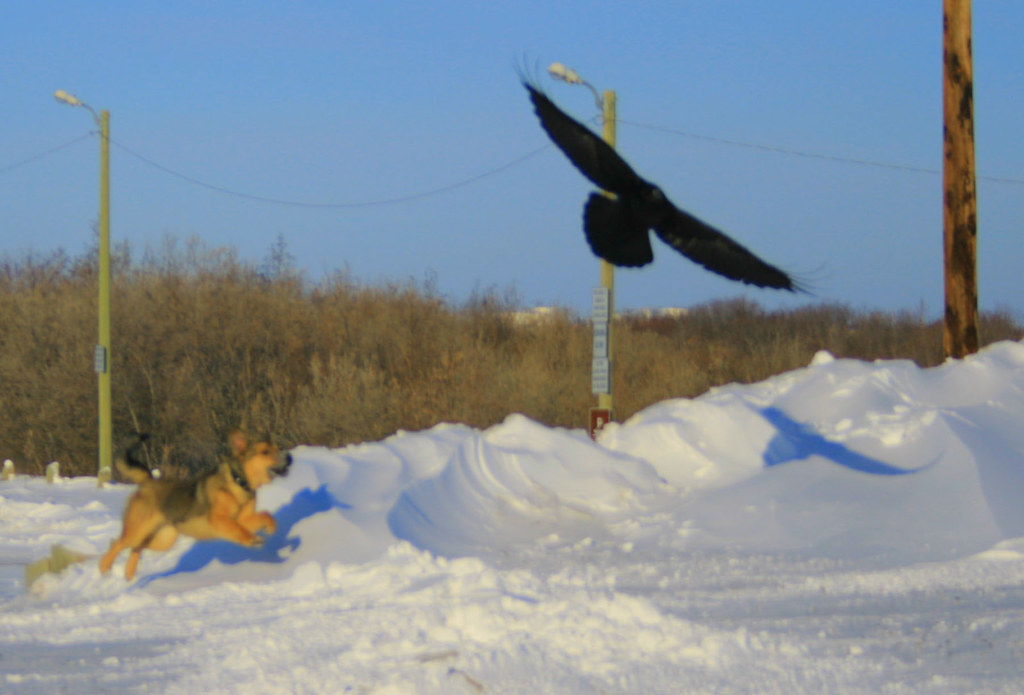

It was about 50 below with wind chill when I took these. The colour is off and the pictures are a bit out of focus. The worst part was when the crow (raven, to be more accurate) hovered on the breeze about five feet above Mac, as if taunting her. Just as I went to snap the picture, my camera was locked up, processing the ten other pictures I had already taken.
Sunday, February 24, 2008
Place of Man
 Inuvik is a town that I described as “ugly” in a post last September. Back then I was just passing through, and I had only spent about an hour on the main drag of town. It was hard to see past its industrial exterior. I am officially withdrawing that remark. After having lived here for almost a full week, I can say that Inuvik is beginning to grow on me.
Maybe it is the rusted ships that dot the edge of the river. Old tugs that may yet be seaworthy and have found shelter from the ice on shore. I have started walking the dog on a route that takes me past three of them- five if it’s warm and I have the energy to go a bit farther. I can almost convince my self I’m back in Newfoundland or some seaside town in Nova Scotia.
Out on the frozen river you can see the headlights of trucks heading to and from Aklavik and Tuktoyaktuk. You can also hear the whine of skidoo engines being wound out and pushed to their limits. They are always in pairs and they seem to be drag racing on that long, straight, flat expanse.

I think part of my newfound love for Inuvik is the landscape. Tulita had nice mountains and rivers, but I felt landlocked there. Here I know that the ocean is just a hundred clicks up river. It is difficult to explain that feeling of being landlocked unless you’ve lived your whole life by the ocean. I remember the first time I went to Ontario when I was 17. The thought would occur to me several times every day that I was so far from the ocean.
Along with the comfort of the ocean is the peace of mind that the road brings. Inuvik is the end of the Dempster Highway. If I was so inclined, I could purchase a beat up car and just hit the road straight down to Dawson, Whitehorse, and BC.
Although I consider myself a pretty cheap guy, and I’m not one to shop for the sake of shopping, it is great to know that there are two hardware stores here in Inuvik. Three if you count the industrial supplies shop. Being a male, I have a gene that predisposes me to love hardware stores. There is no retail outlet more beautiful than one that specializes in practical things. The one possible exception is a bookstore, which Inuvik also has, along with a nice little library, and the Northwest Territories largest magazine stand. You would think that Yellowknife, with 20,000 people, would have the largest magazine stand. But no, it is here in Inuvik, with a population of about 3,000.

Inuvik celebrates its fiftieth birthday this summer. It was founded as a place to resettle the people of Aklavik because that town was - and is - prone to floods. Of course some people refused to move, and Aklavik survives to this day. I hope to travel there in the coming weeks, although our company vehicle does not have four wheel drive at the moment. Inuvik simply means “Place of Man” in the local language. It is the northernmost town in Canada. There are other communities at higher latitudes, but not incorporated towns.
I am loving my job. I can’t put into words how good it feels to go into an office and write every day. I love going out to meet and interview people, but at the end of the day I have to sit down and carve out a story of just 300 to 500 words. It is challenging, but at the same time I know that I can do it. Working at the store became this insurmountable challenge. I knew that no matter how many hours I put in, and no matter how hard I tried, there would always be more to do. I could never be satisfied with the results I received from my efforts. Here I might file a poorly written story, but when it is filed it is done and I can go home knowing I learned from my mistakes and strive for something better next time.
One thing I’ve learned is that people have short attention spans. We try to say more in fewer words. So if you’re still reading this, I’ve already taken you further that the average newspaper article. I will be trying to post more regularly now that I have an abundance of time. This was one of my first real weekends in years. A weekend has to be long enough so you can afford to waste some time without feeling guilty. A weekend isn’t a weekend unless you get to have it on Saturday and Sunday. There is a vibe you get on those days that you just can’t get on a Tuesday.
Sunday, January 06, 2008
Chapter Two
December was long and eventful here in our now-packed-up house. It started with a job offer from Northern News Services, a company based in Yellowknife that publishes weekly and bi-weekly papers all over the Northwest Territories and Nunavut. I had been sending them photos for a while and they had my resume on file, so when a job in Inuvik opened up, they called to ask me if I was interested.
These decisions are not easy to make, especially over the Christmas season, but after talking it over, Nicole and I decided to go for it. It wasn't easy telling everyone at the store that I was leaving, but they were supportive to say the least.
On the 23rd, Nicole started having pains in her stomach. There is no doctor in Tulita, but the nurse called the hospital in Yellowknife and described the symptoms. We were told it was nothing too serious. The pain subsided a bit over Christmas, but by the 29th it was back and we decided that she couldn't wait any longer to go see a doctor. It meant paying several thousand out of our own pocket for a last minute flight to Yellowknife. It is true that health care is free in Canada, but only once you're inside the hospital. How you get there is up to you.
Once inside, the doctors seemed fascinated by Nicole's conflicting symptoms. There was a steady stream of specialists called in from their Christmas holidays to perform test after test. I felt relieved knowing that so many doctors were putting their heads together on her case. I'm sure it was because of her unusual symptoms. We later learned that the patient in the bed next to us had languished for four full days before finding out her appendix had ruptured. They kept telling her no doctors were available to do an ultrasound, even though we knew one had come in the day before to perform an ultrasound on Nicole.
In the end, Nicole's illness wasn't too serious. It was an overreaction of her immune system that was painful more than anything else. It had a long name that even the doctors seemed unable to pronounce. After four nights and five days in Yellowknife, I jetted back to Tulita to begin packing our stuff.
And that brings me to today, my last day living in Tulita. It will be spent ferrying boxes and doing some last-minute packing. Tomorrow afternoon I'll arrive in Yellowknife and begin my career as a journalist. I set out in 2001 with the dream of making a living as a writer. Seven years later I've finally made it a reality. We will see how long it lasts, but at least now I can say I've tried.
By the sounds of things, one of my first tasks as a reporter will be a 10-day road trip through most of the communities in the southern part of the Northwest Territories. I don't want to say too much yet except that if it goes ahead, it will be the trip of a lifetime for me. I can't wait. Not sure when my next posting will be because my computer will be shipped to Inuvik. I'm scheduled to go there sometime in mid-February. Stay tuned.
These decisions are not easy to make, especially over the Christmas season, but after talking it over, Nicole and I decided to go for it. It wasn't easy telling everyone at the store that I was leaving, but they were supportive to say the least.
On the 23rd, Nicole started having pains in her stomach. There is no doctor in Tulita, but the nurse called the hospital in Yellowknife and described the symptoms. We were told it was nothing too serious. The pain subsided a bit over Christmas, but by the 29th it was back and we decided that she couldn't wait any longer to go see a doctor. It meant paying several thousand out of our own pocket for a last minute flight to Yellowknife. It is true that health care is free in Canada, but only once you're inside the hospital. How you get there is up to you.
Once inside, the doctors seemed fascinated by Nicole's conflicting symptoms. There was a steady stream of specialists called in from their Christmas holidays to perform test after test. I felt relieved knowing that so many doctors were putting their heads together on her case. I'm sure it was because of her unusual symptoms. We later learned that the patient in the bed next to us had languished for four full days before finding out her appendix had ruptured. They kept telling her no doctors were available to do an ultrasound, even though we knew one had come in the day before to perform an ultrasound on Nicole.
In the end, Nicole's illness wasn't too serious. It was an overreaction of her immune system that was painful more than anything else. It had a long name that even the doctors seemed unable to pronounce. After four nights and five days in Yellowknife, I jetted back to Tulita to begin packing our stuff.
And that brings me to today, my last day living in Tulita. It will be spent ferrying boxes and doing some last-minute packing. Tomorrow afternoon I'll arrive in Yellowknife and begin my career as a journalist. I set out in 2001 with the dream of making a living as a writer. Seven years later I've finally made it a reality. We will see how long it lasts, but at least now I can say I've tried.
By the sounds of things, one of my first tasks as a reporter will be a 10-day road trip through most of the communities in the southern part of the Northwest Territories. I don't want to say too much yet except that if it goes ahead, it will be the trip of a lifetime for me. I can't wait. Not sure when my next posting will be because my computer will be shipped to Inuvik. I'm scheduled to go there sometime in mid-February. Stay tuned.
Sunday, December 02, 2007
On Coldness
The day I arrived back in Tulita From Fort McPherson in early October, the ground was already blanketed with snow. I was told that it had just fallen the day before I arrived. It hasn’t been above zero degrees Celsius here in Tulita since that day. We have had several heavy snowfalls since. The river is now a frozen mass of ice chunks, and workers are already venturing out on Skidoos to prepare the ice bridge for the winter road.

Last week the temperature dipped to below minus thirty for a few days, before shooting up to minus ten overnight. It struck me how nice minus ten felt after the extreme cold. Most of you living down south rarely feel temperatures as cold as minus thirty on a regular basis. You might think that anything below freezing is cold, but once you become acclimatized to the cold, and as long as you dress properly, you begin to become a connoisseur of the cold. You can judge the difference between zero and minus thirty in the same way you might judge a spring or summer day on the opposite end of the thermometer.

Zero Degrees Celsius to minus 10 - Great weather for walking, even if there is a bit of a breeze. In temperatures down to about minus seven you can comfortably go out without a hat or mitts for 15 minutes or more. It is in this temperature zone that snow is most likely to fall. Snow tends to be wetter and heavier. The sky is usually overcast when it is this warm, the clouds being the cause of the warmer weather.

Minus ten to minus twenty - This is an acceptable cold as long as there is no wind. I enjoy going out on still nights such as this because the air is crisp and the sky is usually clear. It is the best weather for northern lights viewing. Gloves and a hat are a must, but you can take them off for a few minutes without any problems in order to unlock a door or fiddle with the settings on your camera. The snow is dryer and more powdery.
 Minus twenty to minus twenty five - This is the threshold between a nice day and a not so nice day. Minus twenty is still bearable. Once it dips below minus twenty, you think twice about going out. If it is minus twenty-five and the air is stilll, it isn’t too bad. But if there is any wind, you feel it. Regardless of the wind, this is the temperature where the air begins to shock your lungs. When I step outside at this temperature, I always let out a short involuntary cough. Although wind makes this temperature feel much worse, the colder it gets, the less likely it is to be windy.

Minus twenty five to minus thirty five - This is where it gets really cold. Gloves are ineffective at this temperature. You need mittens, and you will often put your thumb in with the rest of your fingers. The air is almost always completely still once it gets this cold. Because the air is still, it can be deceiving. You might think you can run outside for just a minute, and at first you might not even feel the cold the way you might on a damp fall day. But within a minute, any exposed skin will begin to ache. Touching anything made of metal can be dangerous and your skin will register a burning sensation. I find that when I’m out in this weather and my face or hands begin to ache, I will begin to feel a slight panic. I think it is a fight or flight mechanism, as if my body knows that I’m in danger. If I’m five minutes away from the house, I will pick up the pace and do anything to cover up exposed skin.
Thirty five and below - Nobody goes outside if they can help it. Even skidoo riders, who insist on joyriding at twenty below and beyond, stay inside. Your truck will not start unless it is plugged in. The air becomes remarkably still. Breathing can be painful. Frostbite can begin within minutes. Even when you are inside, the floor can feel cold and there is a chill that you cannot shake. Keys will break off inside locks at this temperature (or so I have been told). School is cancelled.
All of this assumes you are wearing a down filled parka, long johns, and properly insulated boots. Cotton long johns are only good down to ten below, after that, fleece long johns are a must if you want to feel comfortable.

Last week the temperature dipped to below minus thirty for a few days, before shooting up to minus ten overnight. It struck me how nice minus ten felt after the extreme cold. Most of you living down south rarely feel temperatures as cold as minus thirty on a regular basis. You might think that anything below freezing is cold, but once you become acclimatized to the cold, and as long as you dress properly, you begin to become a connoisseur of the cold. You can judge the difference between zero and minus thirty in the same way you might judge a spring or summer day on the opposite end of the thermometer.

Zero Degrees Celsius to minus 10 - Great weather for walking, even if there is a bit of a breeze. In temperatures down to about minus seven you can comfortably go out without a hat or mitts for 15 minutes or more. It is in this temperature zone that snow is most likely to fall. Snow tends to be wetter and heavier. The sky is usually overcast when it is this warm, the clouds being the cause of the warmer weather.

Minus ten to minus twenty - This is an acceptable cold as long as there is no wind. I enjoy going out on still nights such as this because the air is crisp and the sky is usually clear. It is the best weather for northern lights viewing. Gloves and a hat are a must, but you can take them off for a few minutes without any problems in order to unlock a door or fiddle with the settings on your camera. The snow is dryer and more powdery.
 Minus twenty to minus twenty five - This is the threshold between a nice day and a not so nice day. Minus twenty is still bearable. Once it dips below minus twenty, you think twice about going out. If it is minus twenty-five and the air is stilll, it isn’t too bad. But if there is any wind, you feel it. Regardless of the wind, this is the temperature where the air begins to shock your lungs. When I step outside at this temperature, I always let out a short involuntary cough. Although wind makes this temperature feel much worse, the colder it gets, the less likely it is to be windy.
Minus twenty five to minus thirty five - This is where it gets really cold. Gloves are ineffective at this temperature. You need mittens, and you will often put your thumb in with the rest of your fingers. The air is almost always completely still once it gets this cold. Because the air is still, it can be deceiving. You might think you can run outside for just a minute, and at first you might not even feel the cold the way you might on a damp fall day. But within a minute, any exposed skin will begin to ache. Touching anything made of metal can be dangerous and your skin will register a burning sensation. I find that when I’m out in this weather and my face or hands begin to ache, I will begin to feel a slight panic. I think it is a fight or flight mechanism, as if my body knows that I’m in danger. If I’m five minutes away from the house, I will pick up the pace and do anything to cover up exposed skin.
Thirty five and below - Nobody goes outside if they can help it. Even skidoo riders, who insist on joyriding at twenty below and beyond, stay inside. Your truck will not start unless it is plugged in. The air becomes remarkably still. Breathing can be painful. Frostbite can begin within minutes. Even when you are inside, the floor can feel cold and there is a chill that you cannot shake. Keys will break off inside locks at this temperature (or so I have been told). School is cancelled.
All of this assumes you are wearing a down filled parka, long johns, and properly insulated boots. Cotton long johns are only good down to ten below, after that, fleece long johns are a must if you want to feel comfortable.
Tuesday, November 06, 2007
Hell Hounds and Little Green Men
People around town have been reporting a wolf on the loose for the past week or so. On Monday, our neighbor’s dog was killed and eaten by a wolf. On Tuesday morning, around 4 a.m., our neighbor Jimmy shot this wolf in his yard.

The picture doesn't really do justice to the size of this dog. It is too bad this big guy couldn’t have stayed out in the wild, but I guess he was tempted by all the snacks tied out in everyone’s yard. We bring our dog in at night.
In other news, people in the town just east of us (only about 100km as the crow flies) spotted a UFO the other morning. It would be easy to pass this off as a star, except the footage was shot in the daytime. Nicole knows the folks who shot this footage. They aren’t they type to go about perpetrating hoaxes. Some reported seeing red lights shooting out of the object. I'm sure there is a rational explanation. My boss thinks it's a drop of water on the camera lens. You be the judge.

The picture doesn't really do justice to the size of this dog. It is too bad this big guy couldn’t have stayed out in the wild, but I guess he was tempted by all the snacks tied out in everyone’s yard. We bring our dog in at night.
In other news, people in the town just east of us (only about 100km as the crow flies) spotted a UFO the other morning. It would be easy to pass this off as a star, except the footage was shot in the daytime. Nicole knows the folks who shot this footage. They aren’t they type to go about perpetrating hoaxes. Some reported seeing red lights shooting out of the object. I'm sure there is a rational explanation. My boss thinks it's a drop of water on the camera lens. You be the judge.
Monday, October 29, 2007
South to Old Fort Point
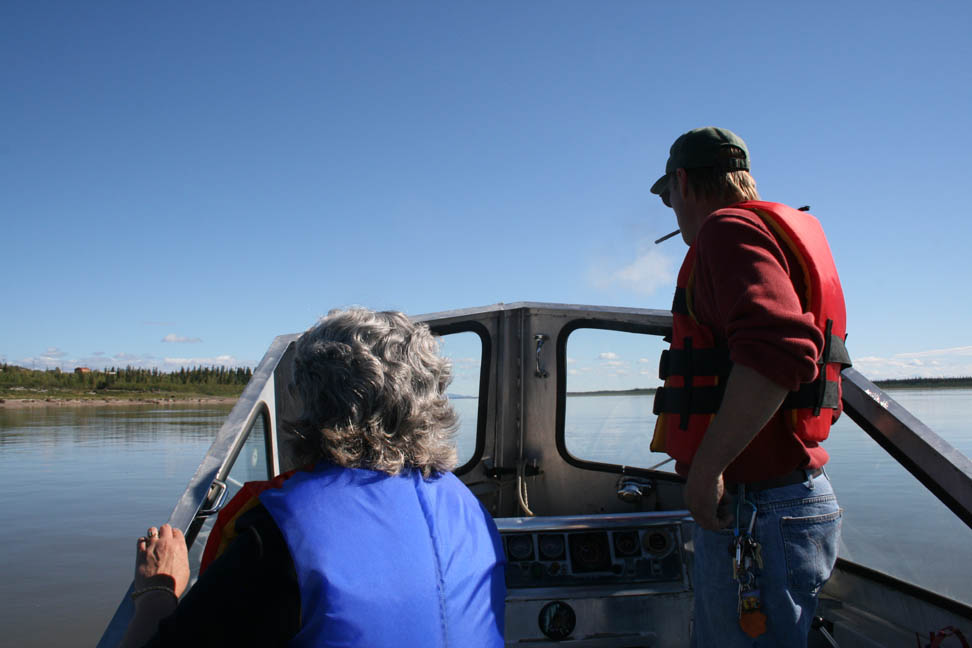 Captain Ron showed up in Tulita the week after he took me four wheeling in Norman Wells. He came by boat on a Saturday, and on Sunday morning he called Nicole and I, asking us if we wanted to go for a little tour south on the Mackenzie.
This was the last weekend in August. It was still summer and it was a sunny, warm day, but we put on sweaters because it can get surprisingly cold out on the water.
Ron’s wife Wendy was along for the ride too. Ron had one of his trademark captain black cigars clutched between his teeth as we drove past flocks of geese and ducks already gathering for their flight south.

We traveled for about an hour and a half past endless trees and rocks. Occasionally we passed groups of cabins and with blue-tarp teepees outside. Ron seemed to know who owned each one.
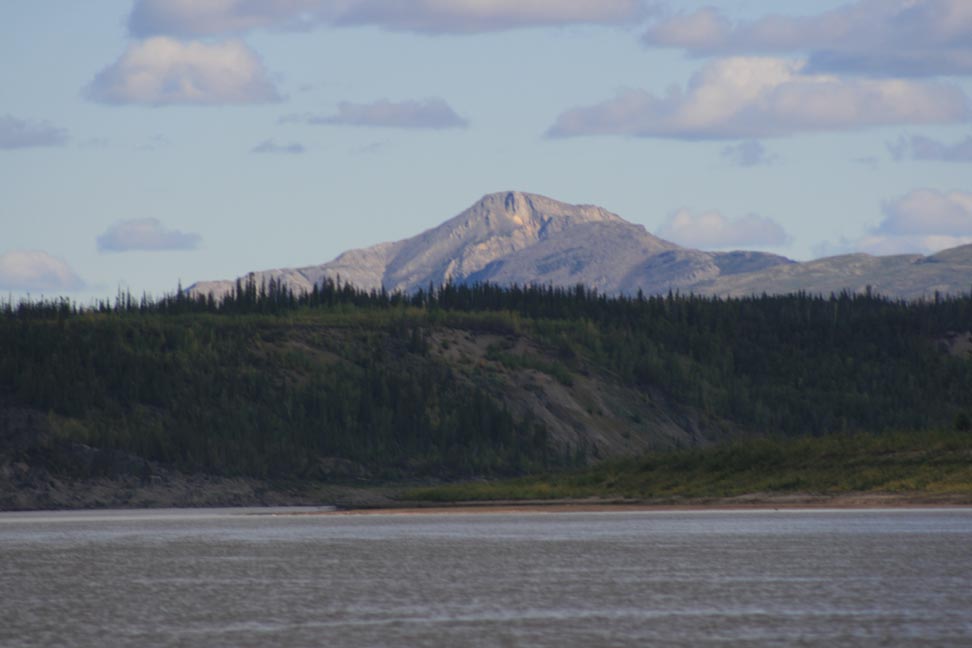
The scenery grew a bit monotonous after a while, but every so often you would round a bend to see a mountain off in the distance. In the exposed cliffs of the riverbank we could see coal seams and once, a layers of kimberlite, the rock geologists look for when they are looking for diamonds.
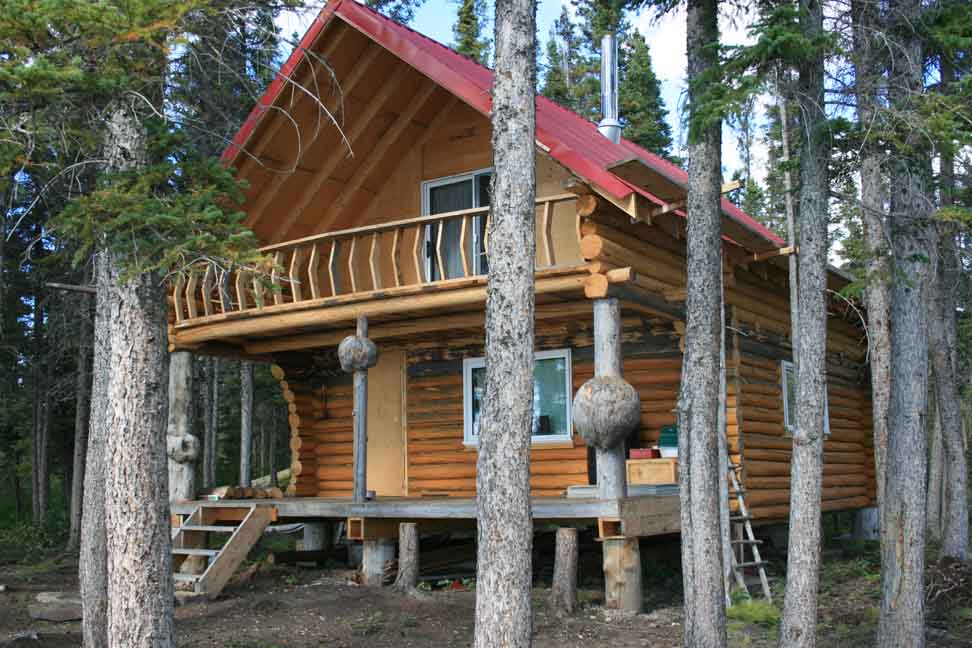
We stopped at “Old Fort Point,” where a family from Tulita has a group of log cabins. No one was home, but we got out to admire the cabins. They were beautifully constructed, but small and humble at the same time. Some were barely twenty feet by twenty feet, but they had all one could ask for.
Old Fort Point was once the site of a fort, possibly the original “Fort Norman” and Ron said you can find the ruins of the fort if you look, but we were starting to run short on time, and he said there wasn’t much to see. No Parks Canada interpretation plaques here. Just the name passed down for several hundred years by the locals.
I was getting cold as we traveled back, but I tried to ignore the discomfort and take in the scenery. About halfway back, someone spotted a black bear on the eastern bank, and Ron spun the boat around so we could go in for a closer look. It of course took off into the woods before we could get really close.
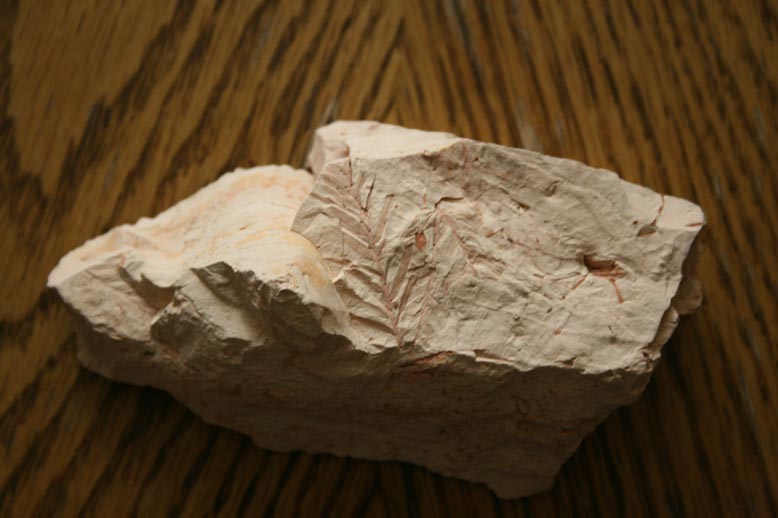
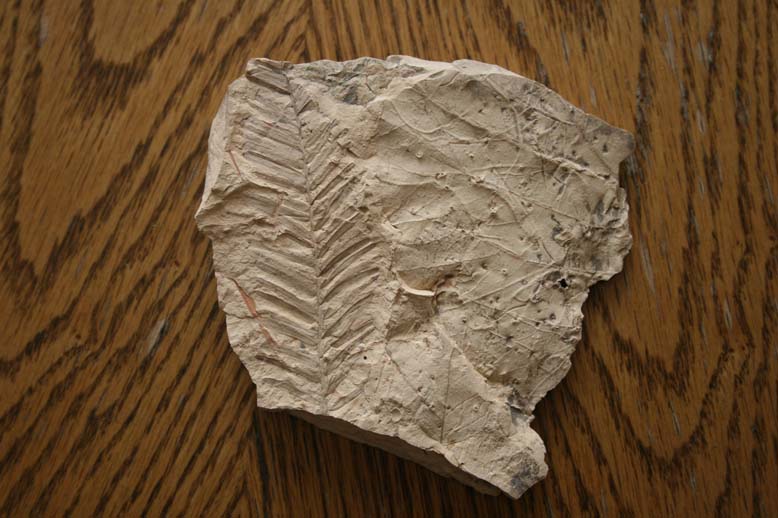
Four miles south of Tulita is a spot known locally as “The Smokes.” It is where an exposed coal seam has been smoldering for hundreds, perhaps thousands of years. Alexander Mackenzie, the explorer for whom the river is named, noted the smoke rolling from the ground when he first paddled up the river in 1789. Although it was getting late in the day, Ron’s wife Wendy insisted that we stop in for a look. They had mentioned something about fossils, but I was unprepared for what we were about to find.
 There was a bit of smoke coming from the cliffs up the river. You could smell it in the air. The beach was littered with pink colored rocks, and on closer inspection we found that each pink rock was covered in leaf imprints. It was literally impossible to pick up a rock that didn’t have an imprint of some kind. The challenge wasn’t finding a fossil, but finding a good, clear imprint that stood out from the tens of thousands of mediocre fossils.
Ron started a small fire to roast some wieners. Nicole, Wendy and I clambered over the banks, collecting some of the better specimens we could find. Ron is an evangelical Christian and he was unimpressed by the fossils. Earlier in the day I had
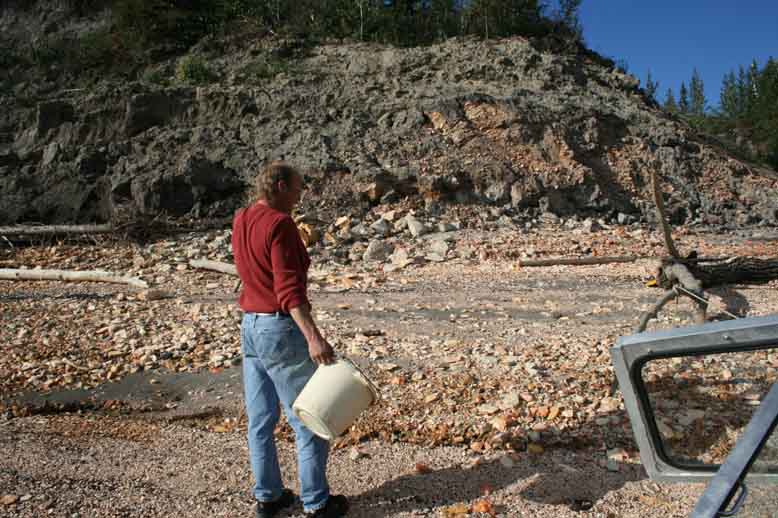 told him about some petrified wood I had found on the banks of Great Bear River, and he told me how wood actually petrifies over decades instead of thousands of years. He said there is a museum in the states has a petrified tennis shoe. Instead of looking for fossils, he filled a Rubbermaid tub with the rocks to use as gravel on his walkway.
With our boat heavily laden with a few hundred extra ponds of rocks, it was difficult to get back up to speed. We arrived back in Tulita around six and unloaded our fossils. Ron still had an hours trip ahead of him north to Norman Wells. We thanked them for another memorable trip.

Monday, October 22, 2007
Owl
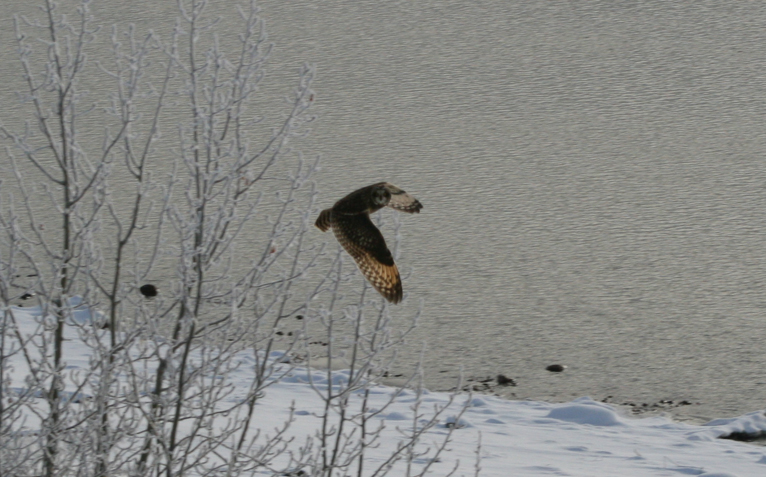
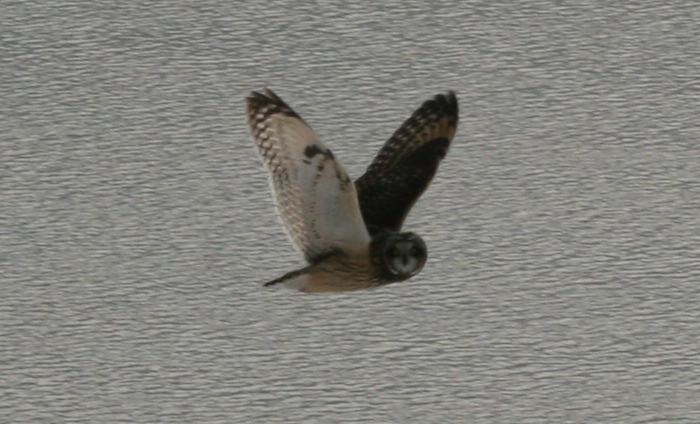
We don’t have as many brushes with wildlife as you might expect here in the north. I’ve seen some wolves from a distance, bears, one moose, and dead caribou, but on Sunday I saw my first owl. I was on the phone with my folks when I saw a brown bird swoop past the warehouses in our front yard. I waved Nicole over. At first we thought it was a Peregrine falcon from the colouring of the wings.
I got bundled up and trudged outside through a foot of snow to get some pictures. As soon as I approached the edge of blueberry hill, I saw the bird take off for the beach. I slowly pursued it but it flew about a kilometers down the beach and perched on a log.
When I got back to the house and downloaded the first pictures, they were blurry at best, but when I zoomed in on pictures of the bird perched on a log, I noticed that it had the shape of a owl.
In the afternoon it returned, so I headed out again and this time the pictures were much better. It was, as I had suspected, an owl.


I got bundled up and trudged outside through a foot of snow to get some pictures. As soon as I approached the edge of blueberry hill, I saw the bird take off for the beach. I slowly pursued it but it flew about a kilometers down the beach and perched on a log.
When I got back to the house and downloaded the first pictures, they were blurry at best, but when I zoomed in on pictures of the bird perched on a log, I noticed that it had the shape of a owl.
In the afternoon it returned, so I headed out again and this time the pictures were much better. It was, as I had suspected, an owl.

Thursday, October 18, 2007
Buttermilk
Fort McPherson’s store shares its trucks with the North Mart in Inuvik, which is the end of the line for the Dempster highway. The delivery truck usually stop in McPherson first to unload their freight, and then continues on to Inuvik.
One night, while we were unloading the truck, Mike the grocery manager noticed something funny.
“It looks like they’ve got a pallet of buttermilk in there! Someone must have really screwed up the order.”
Buttermilk is something I’ve never ordered. Mike once ran the dairy section in the Inuvik store, and he said he usually ordered 12 1 litre cartons. That was for a population of 6000 people.
Today I found out what happened to the buttermilk:
Inuvik inundated with free buttermilk bounty
One night, while we were unloading the truck, Mike the grocery manager noticed something funny.
“It looks like they’ve got a pallet of buttermilk in there! Someone must have really screwed up the order.”
Buttermilk is something I’ve never ordered. Mike once ran the dairy section in the Inuvik store, and he said he usually ordered 12 1 litre cartons. That was for a population of 6000 people.
Today I found out what happened to the buttermilk:
Inuvik inundated with free buttermilk bounty
Saturday, September 29, 2007
Ft. McPherson Journal - Part Three
The other day I was speaking with Sarah, an employee at the store as she was putting out toys. The toys were action figure that included men in fluorescent furs, space-aged snowmobiles, and wooly mammoths. Sarah motioned towards the toy wooly mammoth and told me her father had once found "a...a...whatchacallit....mammoth trunk" up in the mountains. She was pointing to the toy's nose and tusks.
"You mean the tusk? The bone?"
"No. It was the trunk. It was dried out."
She held up her hands about thee feet apart to indicate the size.
I can only assume that it was freeze dried somehow. She said it didn't stink at all and that someone in the family might still have it. She also told me that her father and some others once came across "a whole bunch" of mammoths when they were snowmobiling in the mountains but that "they never went back to that place." Her father is long gone.
Sarah is a wealth of interesting and sometimes disturbing stores. The other day I got off the phone with an elder from town while Sarah was in the office with me, doing some paperwork.
"Who was that?" she asked.
"Oh it was so and so (I don't remember the name) and she's sending her grandson up to charge on her account."
"She doesn't really come around any more, ever since she got shot."
"Shot?"
"Yeah, her brother-in-law. He shot her and four other people in the family."
"Jesus! Was he drunk or what?"
"No. They say when they found him he was still holding the gun and he just kept saying 'why do they always make fun of me? Why do they always make fun of me' over and over again."
"You mean the tusk? The bone?"
"No. It was the trunk. It was dried out."
She held up her hands about thee feet apart to indicate the size.
I can only assume that it was freeze dried somehow. She said it didn't stink at all and that someone in the family might still have it. She also told me that her father and some others once came across "a whole bunch" of mammoths when they were snowmobiling in the mountains but that "they never went back to that place." Her father is long gone.
Sarah is a wealth of interesting and sometimes disturbing stores. The other day I got off the phone with an elder from town while Sarah was in the office with me, doing some paperwork.
"Who was that?" she asked.
"Oh it was so and so (I don't remember the name) and she's sending her grandson up to charge on her account."
"She doesn't really come around any more, ever since she got shot."
"Shot?"
"Yeah, her brother-in-law. He shot her and four other people in the family."
"Jesus! Was he drunk or what?"
"No. They say when they found him he was still holding the gun and he just kept saying 'why do they always make fun of me? Why do they always make fun of me' over and over again."
Saturday, September 22, 2007
One Crow For Sorrow

Death seems more common here in the north. Not death itself, which is a part of life, but tragic death. The death of young people. Last year it was the plane crash. On my first day here in McPherson there was a funeral for a girl who had commited suicide. Today, the husband of an employee at the store was killed in an accident out on the Dempster.
Last night she was excited because he was coming home from working away. She hadn't seen him in a while. He made it home ok, but this morning I learned that he had been killed on his way back to work. I had just delivered them a new washer the other day. I had just ordered them a new king size bed. It hasn't even arrived yet. I wanted to drive down and see her. But I didn't have to because she came in to the store with her kids. You could tell she was crying. Her kids were crying openly, but they bravely marched through the store, picking up some odds and ends, and then renting some movies. I approached her and told her if she needed anything to call. An empty gesture, but one I felt I had to do. I couldn't just look away.
Last week, a bootleger from town rolled her car and walked away unharmed. You can't help but wonder why a hard-working family man could be taken in the same way a week later. I know it's wrong, but I can't help wishing it had been the other way around.

Thursday, September 13, 2007
Ft. McPherson Journal - Part Two
Days 5 through 10
Down through the mountain pass is a flat section and then another smaller pass. In the middle of this second pass, I cross over into the Yukon. I stop for the obligatory picture at the border. Some of my earliest memories are of my dad reading Robert Service to me. Now I am finally in Service's home territory.

Passing in to a different jurisdiction, I instantly notice a difference in the quality of the roads. I'd say they are slightly better than on the Territories' side. The mountains aren't quite as impressive, but beautiful in their own way nonetheless.

It is noon when I cross the border. It has taken me two and a half hours to go 100 km with my frequent stops. I try to push ahead while the road is good and the scenery is mundane. Before long I come to the Arctic Circle rest stop. More obligatory photos, then back on the road.

Eagle Plains, as a destination, is a bit of a let down. I almost knew this would be the case. It is an ugly hotel, restaurant, and gas bar. It was built in 1978 because there was no natural stopping point between Dawson and McPherson. It obviously hasn't been renovated since. It's like walking into a time capsule. A plaque on the wall explains how the site is completely self sufficient as far as power, water, and sewer go. The plaque even brags that TV signals in the rooms come from an "ANIK 2 satellite dish." Wow, the future is here.
There's an old hound dog asleep on the floor in the hotel lobby. I take one look at the restaurant and decide to eat my sandwich instead of eating here. It's cafeteria style, complete with orange plastic trays and coffee mugs straight out of the 70s. The carpet and walls are ugly earth tones. I get the heck out of there and go eat my lunch by the Eagle River. At least the earth tones there are real.
Then it's back the way I came. Nothing much happens until I get close to the border again. I come around a bend and there up ahead is a bull moose, facing towards me and not moving.
Like I said before, delivery trucks are never there when you need them, and always appear at the most inopportune times. As I pull over, I know that about three minutes behind me is an 18 wheeler with a load of vehicles for Inuvik. Somehow I manage to steer the truck over with one hand while reaching for my camera with the other. For some unknown reason I happen to have my zoom lens on my camera. I can't even remember putting it on, but I'm glad it's there now. I manage to rip the lens cap off and snap a few pictures before the 18 wheeler flys past me, scaring the moose into the bushes. I pull ahead to where he was, but there is no sign of him. There's no sign of my lens cap either. I must have tossed it out the window in my mad rush to get my camera out.

Even though I make better time on the way back because I'm not stopping every five minutes, the trip seems longer. I've got my Ipod to keep me company. I arrive back in McPherson right around five o'clock. The trip has taken seven and a half hours. I've burned just over half a tank of gas. At McPherson's prices (1.36/L) that's about $70.00. I don't think I'll be topping that trip any time soon.
WORK
Day 11
It's finally my day off. I was going to take Monday off, but the office lady ended up taking it off instead, which was fine because it rained all day Monday. Today it is warm and dry. I'm planning to drive about 200km south on the Dempster to Eagle Plains, a mid-way truck stop. All week I've been psyching myself up for this trip. Whenever tourists have stopped into the store on their way to Inuvik, I've asked them what the drive is like between Eagle Plains and McPherson. Everyone I asked said it was the most scenic part of the highway. That works for me because I won't be able to drive the next leg of the highway (400+km to Dawson).
Of course as I'm getting ready to go, a truck shows up with freight for the store. They never come when you need them, but always arrive when you're in the middle of something important (like a day off). I go in to help but Mike, the grocery manager, chases me off.
My truck is loaded with junk food, camera gear and fishing gear. I'm thinking about eating lunch at Eagle Plains, but I've brought a sandwich just in case the food there is crappy and/or expensive.
It's a five minute drive from McPherson to the cable ferry which crosses the Peel River. It looks like I'm the first truck of the day. The sign says that the ferry runs 9:30 a.m. to 12:45p.m. There is an old guy directing traffic onto the ferry. The trip across takes less than five minutes, but he comes over and asks me where I'm headed. I tell him and he tells me that I might see some Caribou. There are several herds that migrate across the highway. I pray that I'll see some wildlife. One lady who works at the store warned me not to get out of my truck if I see any grizzlies. Good advice if I ever heard it.
 The highway rolls between some small hills and lakes before rising onto a plateau. Right away I stop at a look off and snap a few pictures of the mist filled Mackenzie Valley below. The sun is still quite low in the sky and I hope that it will be that way when I get to the Richardson Mountains. Any photographer will tell you that early morning and late evening are the golden hours for photography. It's that time when everything has a golden hue and shadows are more dramatic.

I think that the leaves are just a few days past their prime, but the colors are still wonderful. There aren't many trees here on the plateau and the low bushes are varying shades of yellow and red. Down below I can see some mountains, but nothing too spectacular yet. The road is in good shape; very smooth for a gravel road.
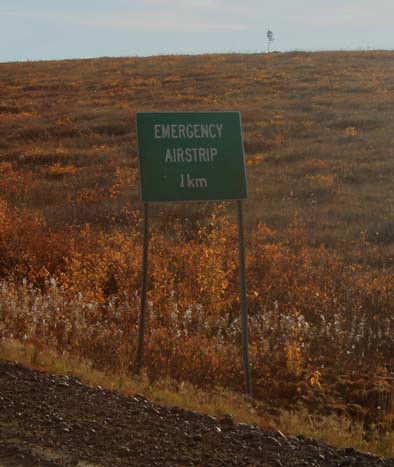
Up ahead I see a sign that says "Emergency Airstrip 1km." It takes a minute for me to realize that this runway isn't beside the highway. It is the highway. The road widens for a few hundred yards and then narrows again. There are orange and red markers on the side of the road. I wonder how often this runway is used.

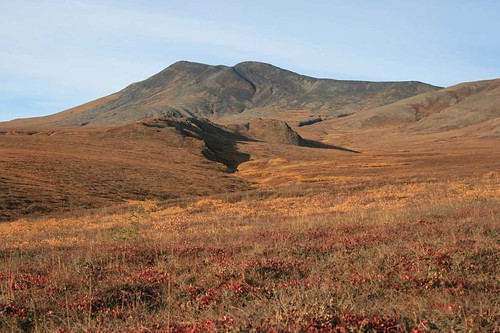
Past the runway I see what I've been waiting for: Mountains. And the road appears to be headed straight for them. I can't help but stop every few kilometers to take a few more pictures of them. IT makes me wonder if I'll ever get to Eagle Plains. Especially when I stop to try fishing at a small nameless creek. As usual I don't have any luck.

Close to the mountain pass they are grading the road. Dump trucks loaded with gravel are barreling up and down the road. It is intimidating to come upon one of these things as they head at you at nearly 100km/h. I move as close to the shoulder as possible. I picture these monster trucks jack-knifing and sliding into me. I picture myself loosing control on the loose gravel and sliding into them. But each time they pass without incident.
Day 11
It's finally my day off. I was going to take Monday off, but the office lady ended up taking it off instead, which was fine because it rained all day Monday. Today it is warm and dry. I'm planning to drive about 200km south on the Dempster to Eagle Plains, a mid-way truck stop. All week I've been psyching myself up for this trip. Whenever tourists have stopped into the store on their way to Inuvik, I've asked them what the drive is like between Eagle Plains and McPherson. Everyone I asked said it was the most scenic part of the highway. That works for me because I won't be able to drive the next leg of the highway (400+km to Dawson).
Of course as I'm getting ready to go, a truck shows up with freight for the store. They never come when you need them, but always arrive when you're in the middle of something important (like a day off). I go in to help but Mike, the grocery manager, chases me off.
My truck is loaded with junk food, camera gear and fishing gear. I'm thinking about eating lunch at Eagle Plains, but I've brought a sandwich just in case the food there is crappy and/or expensive.
It's a five minute drive from McPherson to the cable ferry which crosses the Peel River. It looks like I'm the first truck of the day. The sign says that the ferry runs 9:30 a.m. to 12:45p.m. There is an old guy directing traffic onto the ferry. The trip across takes less than five minutes, but he comes over and asks me where I'm headed. I tell him and he tells me that I might see some Caribou. There are several herds that migrate across the highway. I pray that I'll see some wildlife. One lady who works at the store warned me not to get out of my truck if I see any grizzlies. Good advice if I ever heard it.
 The highway rolls between some small hills and lakes before rising onto a plateau. Right away I stop at a look off and snap a few pictures of the mist filled Mackenzie Valley below. The sun is still quite low in the sky and I hope that it will be that way when I get to the Richardson Mountains. Any photographer will tell you that early morning and late evening are the golden hours for photography. It's that time when everything has a golden hue and shadows are more dramatic.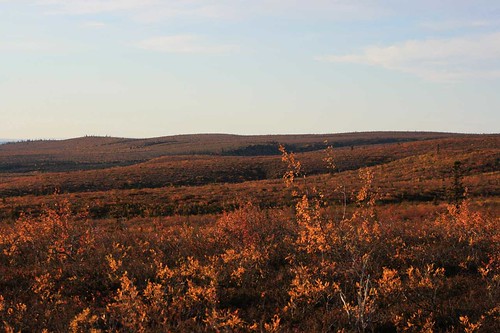
I think that the leaves are just a few days past their prime, but the colors are still wonderful. There aren't many trees here on the plateau and the low bushes are varying shades of yellow and red. Down below I can see some mountains, but nothing too spectacular yet. The road is in good shape; very smooth for a gravel road.
Up ahead I see a sign that says "Emergency Airstrip 1km." It takes a minute for me to realize that this runway isn't beside the highway. It is the highway. The road widens for a few hundred yards and then narrows again. There are orange and red markers on the side of the road. I wonder how often this runway is used.
Past the runway I see what I've been waiting for: Mountains. And the road appears to be headed straight for them. I can't help but stop every few kilometers to take a few more pictures of them. IT makes me wonder if I'll ever get to Eagle Plains. Especially when I stop to try fishing at a small nameless creek. As usual I don't have any luck.
Close to the mountain pass they are grading the road. Dump trucks loaded with gravel are barreling up and down the road. It is intimidating to come upon one of these things as they head at you at nearly 100km/h. I move as close to the shoulder as possible. I picture these monster trucks jack-knifing and sliding into me. I picture myself loosing control on the loose gravel and sliding into them. But each time they pass without incident.
Down through the mountain pass is a flat section and then another smaller pass. In the middle of this second pass, I cross over into the Yukon. I stop for the obligatory picture at the border. Some of my earliest memories are of my dad reading Robert Service to me. Now I am finally in Service's home territory.
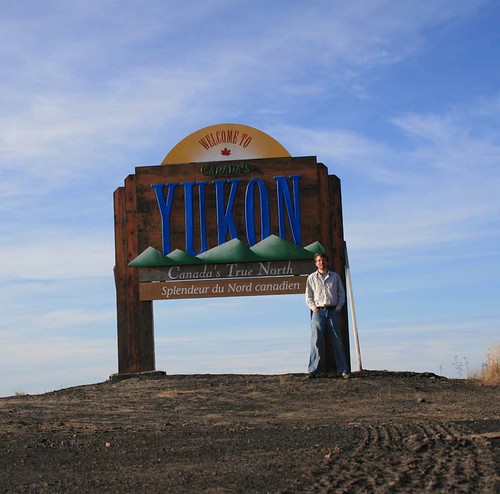
Passing in to a different jurisdiction, I instantly notice a difference in the quality of the roads. I'd say they are slightly better than on the Territories' side. The mountains aren't quite as impressive, but beautiful in their own way nonetheless.
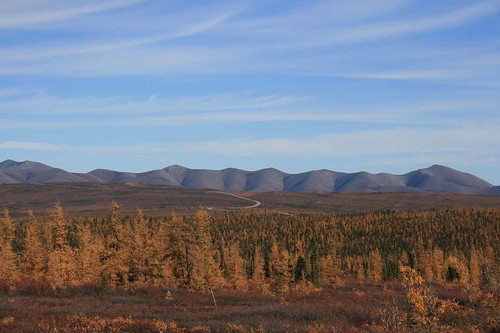
It is noon when I cross the border. It has taken me two and a half hours to go 100 km with my frequent stops. I try to push ahead while the road is good and the scenery is mundane. Before long I come to the Arctic Circle rest stop. More obligatory photos, then back on the road.

Eagle Plains, as a destination, is a bit of a let down. I almost knew this would be the case. It is an ugly hotel, restaurant, and gas bar. It was built in 1978 because there was no natural stopping point between Dawson and McPherson. It obviously hasn't been renovated since. It's like walking into a time capsule. A plaque on the wall explains how the site is completely self sufficient as far as power, water, and sewer go. The plaque even brags that TV signals in the rooms come from an "ANIK 2 satellite dish." Wow, the future is here.
There's an old hound dog asleep on the floor in the hotel lobby. I take one look at the restaurant and decide to eat my sandwich instead of eating here. It's cafeteria style, complete with orange plastic trays and coffee mugs straight out of the 70s. The carpet and walls are ugly earth tones. I get the heck out of there and go eat my lunch by the Eagle River. At least the earth tones there are real.
Then it's back the way I came. Nothing much happens until I get close to the border again. I come around a bend and there up ahead is a bull moose, facing towards me and not moving.
Like I said before, delivery trucks are never there when you need them, and always appear at the most inopportune times. As I pull over, I know that about three minutes behind me is an 18 wheeler with a load of vehicles for Inuvik. Somehow I manage to steer the truck over with one hand while reaching for my camera with the other. For some unknown reason I happen to have my zoom lens on my camera. I can't even remember putting it on, but I'm glad it's there now. I manage to rip the lens cap off and snap a few pictures before the 18 wheeler flys past me, scaring the moose into the bushes. I pull ahead to where he was, but there is no sign of him. There's no sign of my lens cap either. I must have tossed it out the window in my mad rush to get my camera out.
Even though I make better time on the way back because I'm not stopping every five minutes, the trip seems longer. I've got my Ipod to keep me company. I arrive back in McPherson right around five o'clock. The trip has taken seven and a half hours. I've burned just over half a tank of gas. At McPherson's prices (1.36/L) that's about $70.00. I don't think I'll be topping that trip any time soon.
Wednesday, September 05, 2007
Ft. McPherson Journal - Part One

Day 1,
The company has sent me to Ft. McPherson to do a five week relief for a store manager who is on vacation. In honor of my first trip above the Arctic Circle, I've decided to stop shaving until I return south again. I haven't told Nicole this yet. I'm not sure how she'll take the news.
I arrived at the Inuvik airport around 1pm on Friday. Shane, the Ft. McPherson store manager was there to meet me. I came equipped with one bag full of clothes, my camera, and fishing pole.
We drove into Inuvik. It is an ugly town in otherwise beautiful surroundings. Shane had to pick up a part for his water pump, and we went to the North-Mart for some dirty bird (KFC). While waiting for our food, we went down to check out the electronics. I found the fishing section and on an impulse, bought myself a new fishing lure. I'm fairly sure most lures are designed to catch the eyes of fisherman rather than fish. This one was matte black with fluorescent red spots. It's called "the black fury." Even as I was forking over the cash, I wondered what the hell I was doing. It probably won't work anyway.
After picking up a day-old copy of the Globe and Mail (half price!) we got on the Dempster Highway, heading for ft. McPherson. The Dempster highway stretches from just outside of Dawson City to Inuvik, passing mostly through the Yukon before crossing into the territories just above the arctic circle. The highway is only about twenty six years old. To even call it a highway is misleading. It is a well built gravel road with a speed limit of 90km/h. In the winter it becomes an ice road.
The Dempster attracts scores of tree-huggers,weekend warriors, RV-ers, and tour buses. We passed all of the above on our way down. I felt bad for them knowing that their goal was the uninspiring town of Inuvik. Once there, they would have to turn around and drive back. You could see the cloud of dust raised by oncoming trucks a mile away. Slowly but surely they would approach. Both vehicles would slow a bit and move to the side. Some trucks didn't seem to slow at all, and our windshield would be pelted with tiny bits of gravel.
The view was mostly monotonous but strangely beautiful. The trees are in the prime of their fall colors up here. We drove past mile after mile of skinny fir trees and stunted birch with bright yellow leaves.
The Dempster crosses the Mackenzie river at the town of Tsiigehtchic(pronounced sig-a-chick, formerly called Arctic Red River). The M.V. Louis Cardinal ferries vehicles between the eastern side of the river, the Dempster highway on the western side, and the town of Tsiigehtchic, which is separated from the highway by the Arctic red river. We arrived at the river just as the ferry was pulling away with only one vehicle aboard. First it went over to the highway. Then it picked up someone there who had to go to Tsiigehtchic. finally, after about half an hour, it came back for us. Everyone I've spoken to curses the ferry, probably because they have all arrived, as I did, just to see it pull away. However, waiting half an hour is a small price to pay for mobility.
Day 2
You can judge the size of a town in the north by how many RCMP officers it has. Tulita has two. The Wells has four. McPherson qualifies for five.
McPherson (pronounced either Mick-FUR-sun or Mick-FEAR-sun) has about twice the population of Tulita at 800 people. It looks like so many northern towns, with dirt roads and standard northern housing. But there's something about it I like, although I cannot yet tell you exactly what it is.
Day 3
I drive Shane and his wife Alyssa into Inuvik so they can catch their plane. It is Labour Day, but the news stand is still open. I pop in for a Globe and Mail but the rack is empty.
"Do you have any copies of Saturday's Globe in the back?"
"Sorry, all sold out."
I drive around Inuvik for a bit, but there is nothing to see. Ugly residential sections and even uglier industrial sections. The speed limit in town is thirty five. My truck won't even go that slow. I have to accelerate and then coast. I decide to get the hell out of there and back on the highway. I never would have thought that driving one-ten on a dirt road would be so easy. About and hour and a half into the trip, I feel the rear end skidding out as I go around a turn. It is enough to make me back off to ninety.
Day 4
My first full day running the store on my own. The day seems to be going well until I go to put on my glasses after my shower. When I pick them up from the table, the right arm stays behind. I find the screw, but no amount of fiddling can get the damn thing to stay in. So I improvise. I use a bent staple in place of the screw and tape to hold it together.
After work, I get in the company truck, determined to get a line in the water. Out on the highway, the sun is low in the sky. CBC is on the radio.
"I'm Paul Kennedy. This is Ideas."
I cruise just over that next hill for several minutes, certain that I spotted a good fishing spot last week. Finally I stop at a lake that looks as good as any other. There is a small space on the side of the road, just large enough to park a truck without impeding traffic.
To get to the water, I soon realize that I'm not walking on ground at all. I'm walking on thick underbrush: dense and springy shrubs that grow out of marshy bog. It's ok for walking, as long as I look where I'm going, but as soon as I stop, the shrubs slowly give way. I cast twice before I start to feel the bog water seeping through my Adidas.
"To hell with it," I say.
However, my fishing is soon interrupted. It is silent out here, even though I'm less than a hundred yards from the so-called highway. But coming from the other side of the lake, I can hear someone calling "Hello!."
It is most definitely human. Of this, I am at first sure. I'm taken aback because it is out of place. I would have been less surprised to see a bear.
There is no sense of panic in the voice. Not much friendliness either. After two hellos, I yell back. There is another hello back, exactly the same as the last. It must be some lost hiker, I think to myself. Or someone fishing on the other side. There it is again.
"Hello!"
"Are you alright?" I yell.
"Hello!"
"Hello?"
"Hello!"
Then I see it. A loon swims into sight. I feel so stupid. luckily there is no one for miles who might have heard me. I guess he spotted a wet footed boobie and he wanted to move in for a closer look. Later his partner appears and they watch me fight with my lure, which is caught on a bush at the water's edge.
I don't stay long. About half an hour. But when I get back in the truck, Paul Kennedy is gone. The local radio station has taken over the frequency. With Buck Owens singing in the background, a woman is reading messages in that slow, monotone northern accent.
"This message is for Andrew Snowshoe. please Go down to the end of miller creek tomorrow to meet Judith and Dan. This message is for Ira Koe. If your listening, call home on channel 22 for an important message..."
Buck Owens comes through the AM radio loud and tinny. They call it country music for a reason. It's enough to drive you insane in the city, but I don't think I could handle anything post nineteen-eighty while driving into a dirt-road town with clapboard sidewalks. A kid is walking up the road and firing stones at a light pole, just to see if he can hit it. The sun is setting on my left, and there's a cloud of dust rising behind that truck that is driving this way.
The company has sent me to Ft. McPherson to do a five week relief for a store manager who is on vacation. In honor of my first trip above the Arctic Circle, I've decided to stop shaving until I return south again. I haven't told Nicole this yet. I'm not sure how she'll take the news.
I arrived at the Inuvik airport around 1pm on Friday. Shane, the Ft. McPherson store manager was there to meet me. I came equipped with one bag full of clothes, my camera, and fishing pole.
We drove into Inuvik. It is an ugly town in otherwise beautiful surroundings. Shane had to pick up a part for his water pump, and we went to the North-Mart for some dirty bird (KFC). While waiting for our food, we went down to check out the electronics. I found the fishing section and on an impulse, bought myself a new fishing lure. I'm fairly sure most lures are designed to catch the eyes of fisherman rather than fish. This one was matte black with fluorescent red spots. It's called "the black fury." Even as I was forking over the cash, I wondered what the hell I was doing. It probably won't work anyway.
After picking up a day-old copy of the Globe and Mail (half price!) we got on the Dempster Highway, heading for ft. McPherson. The Dempster highway stretches from just outside of Dawson City to Inuvik, passing mostly through the Yukon before crossing into the territories just above the arctic circle. The highway is only about twenty six years old. To even call it a highway is misleading. It is a well built gravel road with a speed limit of 90km/h. In the winter it becomes an ice road.
The Dempster attracts scores of tree-huggers,weekend warriors, RV-ers, and tour buses. We passed all of the above on our way down. I felt bad for them knowing that their goal was the uninspiring town of Inuvik. Once there, they would have to turn around and drive back. You could see the cloud of dust raised by oncoming trucks a mile away. Slowly but surely they would approach. Both vehicles would slow a bit and move to the side. Some trucks didn't seem to slow at all, and our windshield would be pelted with tiny bits of gravel.
The view was mostly monotonous but strangely beautiful. The trees are in the prime of their fall colors up here. We drove past mile after mile of skinny fir trees and stunted birch with bright yellow leaves.
The Dempster crosses the Mackenzie river at the town of Tsiigehtchic(pronounced sig-a-chick, formerly called Arctic Red River). The M.V. Louis Cardinal ferries vehicles between the eastern side of the river, the Dempster highway on the western side, and the town of Tsiigehtchic, which is separated from the highway by the Arctic red river. We arrived at the river just as the ferry was pulling away with only one vehicle aboard. First it went over to the highway. Then it picked up someone there who had to go to Tsiigehtchic. finally, after about half an hour, it came back for us. Everyone I've spoken to curses the ferry, probably because they have all arrived, as I did, just to see it pull away. However, waiting half an hour is a small price to pay for mobility.
Day 2
You can judge the size of a town in the north by how many RCMP officers it has. Tulita has two. The Wells has four. McPherson qualifies for five.
McPherson (pronounced either Mick-FUR-sun or Mick-FEAR-sun) has about twice the population of Tulita at 800 people. It looks like so many northern towns, with dirt roads and standard northern housing. But there's something about it I like, although I cannot yet tell you exactly what it is.
Day 3
I drive Shane and his wife Alyssa into Inuvik so they can catch their plane. It is Labour Day, but the news stand is still open. I pop in for a Globe and Mail but the rack is empty.
"Do you have any copies of Saturday's Globe in the back?"
"Sorry, all sold out."
I drive around Inuvik for a bit, but there is nothing to see. Ugly residential sections and even uglier industrial sections. The speed limit in town is thirty five. My truck won't even go that slow. I have to accelerate and then coast. I decide to get the hell out of there and back on the highway. I never would have thought that driving one-ten on a dirt road would be so easy. About and hour and a half into the trip, I feel the rear end skidding out as I go around a turn. It is enough to make me back off to ninety.
Day 4
My first full day running the store on my own. The day seems to be going well until I go to put on my glasses after my shower. When I pick them up from the table, the right arm stays behind. I find the screw, but no amount of fiddling can get the damn thing to stay in. So I improvise. I use a bent staple in place of the screw and tape to hold it together.
After work, I get in the company truck, determined to get a line in the water. Out on the highway, the sun is low in the sky. CBC is on the radio.
"I'm Paul Kennedy. This is Ideas."
I cruise just over that next hill for several minutes, certain that I spotted a good fishing spot last week. Finally I stop at a lake that looks as good as any other. There is a small space on the side of the road, just large enough to park a truck without impeding traffic.
To get to the water, I soon realize that I'm not walking on ground at all. I'm walking on thick underbrush: dense and springy shrubs that grow out of marshy bog. It's ok for walking, as long as I look where I'm going, but as soon as I stop, the shrubs slowly give way. I cast twice before I start to feel the bog water seeping through my Adidas.
"To hell with it," I say.
However, my fishing is soon interrupted. It is silent out here, even though I'm less than a hundred yards from the so-called highway. But coming from the other side of the lake, I can hear someone calling "Hello!."
It is most definitely human. Of this, I am at first sure. I'm taken aback because it is out of place. I would have been less surprised to see a bear.
There is no sense of panic in the voice. Not much friendliness either. After two hellos, I yell back. There is another hello back, exactly the same as the last. It must be some lost hiker, I think to myself. Or someone fishing on the other side. There it is again.
"Hello!"
"Are you alright?" I yell.
"Hello!"
"Hello?"
"Hello!"
Then I see it. A loon swims into sight. I feel so stupid. luckily there is no one for miles who might have heard me. I guess he spotted a wet footed boobie and he wanted to move in for a closer look. Later his partner appears and they watch me fight with my lure, which is caught on a bush at the water's edge.
I don't stay long. About half an hour. But when I get back in the truck, Paul Kennedy is gone. The local radio station has taken over the frequency. With Buck Owens singing in the background, a woman is reading messages in that slow, monotone northern accent.
"This message is for Andrew Snowshoe. please Go down to the end of miller creek tomorrow to meet Judith and Dan. This message is for Ira Koe. If your listening, call home on channel 22 for an important message..."
Buck Owens comes through the AM radio loud and tinny. They call it country music for a reason. It's enough to drive you insane in the city, but I don't think I could handle anything post nineteen-eighty while driving into a dirt-road town with clapboard sidewalks. A kid is walking up the road and firing stones at a light pole, just to see if he can hit it. The sun is setting on my left, and there's a cloud of dust rising behind that truck that is driving this way.
Subscribe to:
Posts (Atom)